What are jowls ?
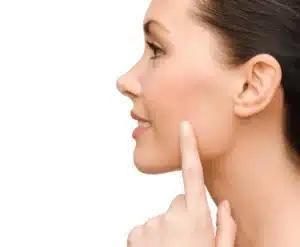
Jowls are small pockets of fat that extend below the lower edge of the jaw on either side of the chin. The facial contour then loses definition, making the face look more tired and older.
The development of jowls is one of the most visible signs of sagging along the facial contour and is often accompanied by a double chin.
However, these two aesthetic concerns should not be confused : a double chin is located beneath the chin, whereas jowls form on either side of it.

Why do jowls develop with age ?
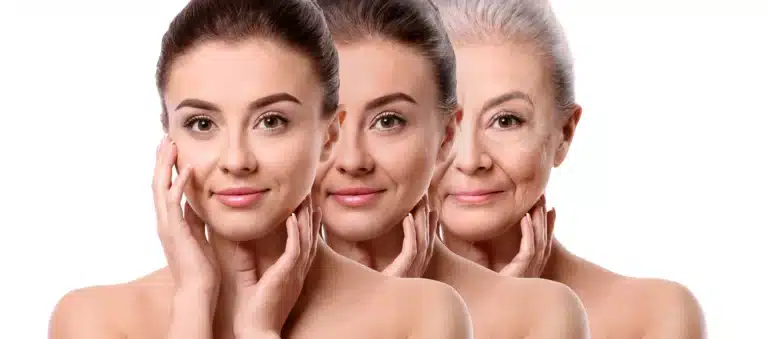
Over the years, several anatomical changes contribute to sagging facial tissues and the development of jowls :
- Bone resorption : the mandibular bone gradually loses volume and provides less support to the tissues covering it.
- Loss of deep fat : the deep fat compartments lose volume and provide less support to facial structures.
- Displacement of superficial fat : the fat compartments in the lower third of the face sag and collect in the lower third of the face.
- Reduced collagen and elastin : the skin loses firmness and elasticity, accentuating sagging along the facial contour.
- Ligament laxity : the ligaments that hold facial tissues in place lose some of their supporting ability.
Stages of jowl sagging
The choice of treatment for jowls depends largely on the extent of tissue sagging. Three degrees of sagging can be distinguished :
| Degree of sagging | Characteristics |
|---|---|
| Mild | The facial contour begins to lose definition. Jowls are subtle and mainly visible from a three-quarter view. |
| Moderate | Jowls are clearly visible, even when the face is at rest. The jawline is less defined and the skin has lost firmness. |
| Severe | Jowls extend well below the lower edge of the jaw. Tissue sagging may be accompanied by excess skin. |
Aesthetic medicine treatments achieve better results when jowls are mild to moderate. When tissue sagging is too pronounced, a surgical facelift may be necessary.
At what age do jowls appear and what factors make them worse ?
Jowls generally start to appear from the forties onwards. In some people, they can develop earlier because of facial morphology or a lack of skin firmness.
A receding chin, a poorly defined jaw or naturally full cheeks are all factors that may contribute to their early development.
Smoking, repeated sun exposure, significant weight fluctuations and hormonal changes associated with menopause also contribute to skin laxity.
Jowls can become more visible following rapid weight loss. When the face loses a great deal of volume and the skin lacks the elasticity needed to retract, the tissues tend to sag further.
How can jowls be treated without surgery ?
To soften jowls without surgery, it is possible to address facial volume and skin firmness. Depending on the cause of the jowls and the degree of skin laxity, several treatments may be offered and combined.
Hyaluronic acid injections
There are two ways to soften jowls through hyaluronic acid injections.
The first involves restoring lost volume in the middle third of the face to provide renewed support to tissues that have sagged over time.
The second involves filling the hollow that forms between the chin and the jowl when it is related to bone or fat loss. This technique helps restore a more defined jawline and improve the appearance of the jowl.
These two techniques can be combined. The jowls themselves should not be injected, as this risks increasing their volume and making the lower third of the face appear heavier.
Sculptra
Sculptra is a collagen stimulator based on poly-L-lactic acid. By stimulating natural collagen production, it helps increase tissue density and gradually restore facial volume.
This treatment is particularly useful when jowls develop alongside hollowing of the cheeks and loss of skin firmness.
Radiofrequency
Radiofrequency heats the deeper tissues in a controlled manner to stimulate collagen production. Over successive sessions, the skin gradually becomes firmer.
This treatment can soften jowls when skin laxity is still mild or moderate.
Lasers
Ablative lasers stimulate collagen production, improve skin density and restore firmness.
Lasers are particularly indicated when the skin of the lower third of the face becomes thinner, has lost firmness and shows fine lines.
However, their effectiveness remains limited when jowls are mainly due to sagging of the deeper tissues.

How can jowls be lifted with a non-surgical facelift ?
The principle of a non-surgical facelift is to use hyaluronic acid injections to restore the deep facial volumes that have diminished with age and no longer provide sufficient tissue support.
To soften jowls, it is therefore not always necessary to inject hyaluronic acid into the lower third of the face. Injections at strategic facial sites can restore certain support points and help achieve a better-defined facial contour. This is notably the principle of the 8-point lift developed by the surgeon Mauricio de Maio.
Sometimes, a non-surgical facelift can be complemented by hyaluronic acid injections into the lower third of the face to redefine its contour.
This technique gives good results for early jowls. When the tissues have sagged too far, injections cannot achieve the same lifting effect as surgery.
What is the best treatment for jowls ?
There is no universal treatment for jowls. The choice mainly depends on the anatomical structure responsible for their development.
| Predominant cause | Possible treatment |
|---|---|
| Loss of support and volume deficits | Hyaluronic acid |
| Diffuse loss of volume and tissue density | Sculptra |
| Early skin laxity | Radiofrequency |
| Thin, crepey and loose skin | Ablative lasers |
| Excess skin and significant sagging | Surgical assessment |
Several treatments may be combined when different anatomical structures are involved.
Dr Romano assesses skin quality, mandibular projection, fat volumes and previous injections before proposing a treatment plan.
Can jowls be completely removed without surgery ?
It all depends on how pronounced the jowls are. When they are mild or moderate, hyaluronic acid injections, combined if necessary with treatments to firm the skin, can soften them and restore a well-defined facial contour.
When jowls are more pronounced, medical treatments offer more limited results. Trying to improve jowls by injecting too much hyaluronic acid along the jawline risks making the lower third of the face appear heavier.
When jowls are significant and accompanied by excess skin, it is preferable to consider a face and neck lift.
What is the price of jowl treatment in Geneva ?
The price of jowl treatment depends on the degree of sagging, the techniques selected and the number of areas to be treated.
| Treatment | Price |
|---|---|
| Hyaluronic acid | CHF 600 per syringe |
| Sculptra | CHF 900 per vial |
| Laser photorejuvenation | From CHF 500 per session |
| Radiofrequency | On quotation |
During the consultation in Geneva, Dr Valeria Romano analyses the causes of sagging and determines the indicated treatments. A personalised quotation allows the overall cost to be assessed.
A publication on jowls describes the different factors contributing to their formation: loss of support, changes in fat, skin laxity and muscle activity. Examination helps identify the role of each factor in an individual patient and select an appropriate treatment. Injections can be used in non-surgical lifting techniques, but cannot always treat jowls.
In a trial of hyaluronic acid injections for redefining the jawline, an improvement was observed at six months in 69% of treated patients, compared with 38% in the control group. Treated patients were also more satisfied with the harmony of their face. These results show better jawline definition with an improvement in jowls.
In a clinical trial, hyaluronic acid injections were assessed for redefining the jawline. At three months, an improvement was observed in 85.1% of treated patients, compared with 14.3% in the control group. In many patients, the correction remained visible for up to two years. Some had received maintenance treatment and others had not, depending on their group. These results concern the gel and protocol studied.
Frequently asked questions
Does losing weight make jowls disappear?
Weight loss does not always make jowls disappear, as their development is not solely related to excess fat. Losing weight may even accentuate skin laxity and make the cheeks look more hollow.
Why do I have jowls when my cheeks are hollow?
With age, the deep fat in the cheeks loses volume, while the superficial fat tends to descend towards the lower third of the face. It is therefore common to have both hollow cheeks and jowls.
Can massage and gua sha lift jowls?
No. Facial massage and gua sha only promote lymphatic drainage.
Can jowls be reduced without making the lower face look fuller?
Jowls can be reduced by restoring tissue support; this is notably the principle behind a nonsurgical facelift using hyaluronic acid injections. This helps reduce jowls without adding heaviness to the lower third of the face.
Why is one jowl more pronounced than the other?
The two sides of the face are never perfectly symmetrical and do not necessarily age in the same way. Differences in bone structure, fat volume and tissue laxity explain why one jowl may be more pronounced than the other. Treatment must therefore be adapted to each side of the face.
Can pronounced jowls be completely eliminated without surgery?
Aesthetic medicine treatments give better results when jowls are mild or moderate. When the tissues have sagged considerably and there is significant excess skin, a surgical facelift remains the most suitable treatment.
Further reading
The role of skin laxity, the displacement of fatty tissues and the loss of support in the development of jowls.
I want to get rid of my jowls: what can I do?
The options for correcting jowls and the limitations of treatments according to the degree of sagging.
The factors that determine the cost of jowl treatment according to the technique and the areas to be treated.