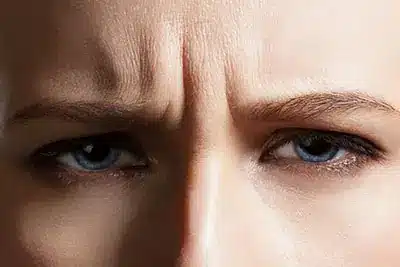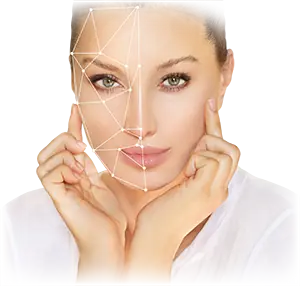
Why do I look severe?
Ageing and facial dynamics contribute to severity.
Comprehensive diagnosis identifies individual muscular, laxity or volume causes.
- Muscles: depressor muscles become overactive, creating harsh tension, particularly those causing frown lines or lowering mouth corners.
- Volume loss / ageing: reduced volume and lax tissues cause sagging and accentuate folds.
- Skin changes: reduced firmness and elasticity, more visible, established wrinkles and laxity.

What makes us look
severe?
Clinical signs combine to change overall expression. Rarely one isolated factor, changes involve skin, muscles and bone ageing.
Common characteristics include:
- Harsh or closed eyes, particularly with under-eye circles.
- Frown lines and furrowed eyebrows.
- Downturned mouth corners.
- Development of marionette lines.
- Temple and cheek volume loss.
- Skin changes: reduced elasticity and firmness, uneven texture, dullness, marked dehydration, wrinkles and fine lines.
These contribute to an authoritative or distant expression.
Solutions for a less severe appearance
Treatment softens expression lines, fills hollows and improves quality. Botulinum toxin and hyaluronic acid are most common. Peels, mesotherapy or Skinboosters also improve quality and radiance.
Effective care identifies precise mechanisms through a comprehensive medical approach for suitable treatment.
Correcting a severe appearance with botulinum toxin
Botulinum toxin modulates contraction by temporarily blocking nerve transmission to relax targeted muscles. For severity, it relaxes frown and forehead-line muscles.
The aim is natural, softened expression rather than freezing.
Eyes become more open, features relaxed and expression softer. Effects develop over days and generally last four to six months.
Correcting a severe appearance with hyaluronic acid injections
Volume loss is a major cause. Age loosens structures and changes natural curves. Restoring volume supports tissues, harmonises contours and corrects sagging.
Hyaluronic acid commonly treats cheekbones, temples, tear troughs and contours. Repositioning creates a natural lift without surgery, reducing shadows for a rested, softer appearance.
It is therefore used for medical lifting and filling to restore lost volume.
Correcting downturned mouth corners with injections
Hyaluronic acid is the most used solution for downturned mouth corners. Medical lifting treats support structures and tightens sagging tissues for a rested, harmonious face.
Targeted filling also compensates for ageing volume loss, particularly in the lower third, supporting mouth corners and correcting their downward direction.
Improving skin quality
Skin quality is essential: impairment accentuates severity, fatigue and harshness.
Skinboosters, mesotherapy and collagen-stimulating Sculptra improve texture, radiance and firmness.
Personalisation is essential. Standardised correction risks artificial results. Precise diagnosis, tailored strategy and gradual steps preserve harmony and identity.
In a trial involving 45 patients, three botulinum toxin injection patterns in the upper face were compared. Eyebrow position varied with the injection points: the outer ends lifted, while the central parts responded differently according to the pattern used. These observations highlight the importance of tailoring injections to soften the gaze while preserving eyebrow balance.
A synthesis of eleven studies involving 585 patients examines changes in eyebrow shape and height after botulinum toxin injections. Elevation of the brow tail varied according to the technique used. These results suggest that a targeted correction can open up the eye area when eyebrow position gives it a closed appearance. The choice of injection points is based on examination of the muscles that raise and lower the brows.
Publications on satisfaction after botulinum toxin injections report generally favourable results, particularly for frown lines. However, satisfaction varies with the area treated, injected dose and assessment criteria. The authors highlight the importance of clarifying the patient’s expectations before treatment to reduce wrinkles while preserving a natural expression.
Frequently asked questions about a severe appearance
What are the signs of a severe appearance?
Typical signs are frown lines, furrowed eyebrows, closed eyes and harsh features.
What is the main cause of a severe appearance?
Muscular activity: some muscles remain contracted at rest, creating harshness or closed expression.
How can a severe appearance be corrected without surgery?
Mainly botulinum toxin relaxes responsible muscles. (It is indicated exclusively for moderate to severe expression lines between the eyebrows and at the eye corners.)
Can a severe appearance be prevented?
Yes, early treatment limits established wrinkles and preserves natural expression.