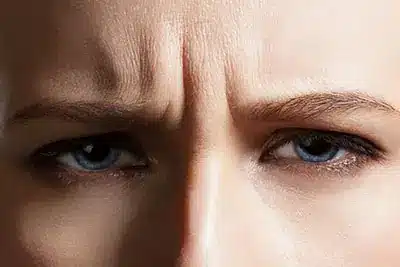
Why do I look sad?
Several mechanisms, mostly ageing but also individual factors, explain a sad appearance.
- Volume loss: facial fat diminishes, cheekbones flatten, temples hollow and gravity pulls tissues downward.
- Changed light and shadow: youthful volume catches light with few visible hollows. Age deepens hollows and shadows, reducing luminosity.
- Muscular action: some muscles pull structures down, increasingly with time.
- Laxity: reduced collagen, elastin and deep support diminish firmness and elasticity.
- Individual factors: genetics, lifestyle (sun, smoking, stress) and facial morphology.

What creates a sad appearance?
A combination of elements changes overall facial balance.
- Upper-face descent: eyebrow tails and outer eye corners lower, closing eyes for a tired or severe appearance.
- Hollow, darkened eyes: under-eye hollows and tear troughs create shadows, fatigue and melancholy.
- Midface laxity: reduced cheekbone volume and sagging tissues produce nasolabial folds.
- Downward mouth corners with marionette lines.
- Lax facial contours, sometimes with jowls.
- A less luminous complexion.
What can help me stop looking sad?
Correction uses tailored medical treatment.
Consultation analyses the whole face, proportions, volume and muscular dynamics.
Usually, reduced volume support and changed light and shadow are responsible.
A comprehensive approach is essential, rather than treating one wrinkle or area.
Restoring facial volume
Restoring volume is essential for facial support.
Cheekbones are often central: restored volume indirectly lifts tissues and softens nasolabial folds.
Temples are often treated for overall harmony.
Hyaluronic acid restores volume and supports sagging structures for a true non-surgical medical facelift effect.
Correcting under-eye hollows and the tear trough
Specially designed hyaluronic acid treats under-eye hollows and tear troughs.
Filling hollows reduces shadows and restores rested, luminous eyes.
This delicate anatomy and very thin skin require great precision.
Softening marionette lines
Hyaluronic acid, using medical lifting and wrinkle filling if needed, softens marionette lines and neutralises mouth-corner direction without changing the smile.
Improving skin quality
Brighter skin reflects light better and reduces fatigue. Skinboosters, peels and fractional ablative lasers improve texture, radiance and evenness.
Redefining facial contours
Contour treatment defines the jaw and reduces jowls.
This restores a younger, more dynamic structure.
Hyaluronic acid tightens lax tissues through medical lifting and defines the jaw through jawline contouring.
Botulinum toxin injections
Botulinum toxin has an important role.
It relaxes depressor muscles, particularly those lowering eyebrows, opening the eyes (*).
(*) Botulinum toxin is indicated only for temporarily reducing certain expression lines, particularly marked, bothersome frown lines and crow's feet.
It is not intended to lift eyebrows, but relaxation may create a slight opening effect.
In a publication on hyaluronic acid injections, the authors explain that a face can look sad without the person feeling sadness. They recommend examining the cheeks, marionette lines, nasolabial folds and facial contours to identify what gives this expression. Injections are then tailored to the volume and support losses observed. This publication explains how to prepare treatment.
In a prospective study, hyaluronic acid injections were used to reduce marionette lines, the folds running from the mouth corners towards the chin. One month after treatment, these folds were less marked in 69.9% of the 83 participants who completed the study, with an improvement of at least one grade on the scale used. Patients were also more satisfied with their facial appearance. The protocol allowed a touch-up.
In a prospective study involving 90 adults, hyaluronic acid injections were performed in the cheeks and cheekbones. According to each patient’s needs, they aimed to restore volumes, support tissues or redefine facial contours. Throughout the twenty-four-week follow-up, at least 92% of patients showed an aesthetic improvement. The study assessed outcomes in these areas without measuring whether the face looked less sad after treatment.
Frequently asked questions about a sad appearance
Why do I look sad for no reason?
Volume loss, sagging tissues and shadows change expression independently of emotions.
What are the signs of a sad appearance?
Under-eye hollows, tear troughs, marionette lines, lowered cheekbones and downturned mouth corners.
Does ageing make the face look sad?
Yes, it is the main cause. Volume support diminishes, tissues descend and light distribution changes.
Can a sad appearance be corrected without surgery?
Yes, hyaluronic acid and botulinum toxin effectively correct it without surgery.
How do injections correct a sad appearance?
They restore volume, fill hollows and rebalance expressions for a rested, more open look.
Is botulinum toxin useful for a sad appearance?
Yes, relaxing muscles pulling eyebrows down opens the eyes.
At what age can a sad appearance be treated?
No fixed age. Treatment depends on signs, sometimes from 30.