What is fractional CO₂ laser ?
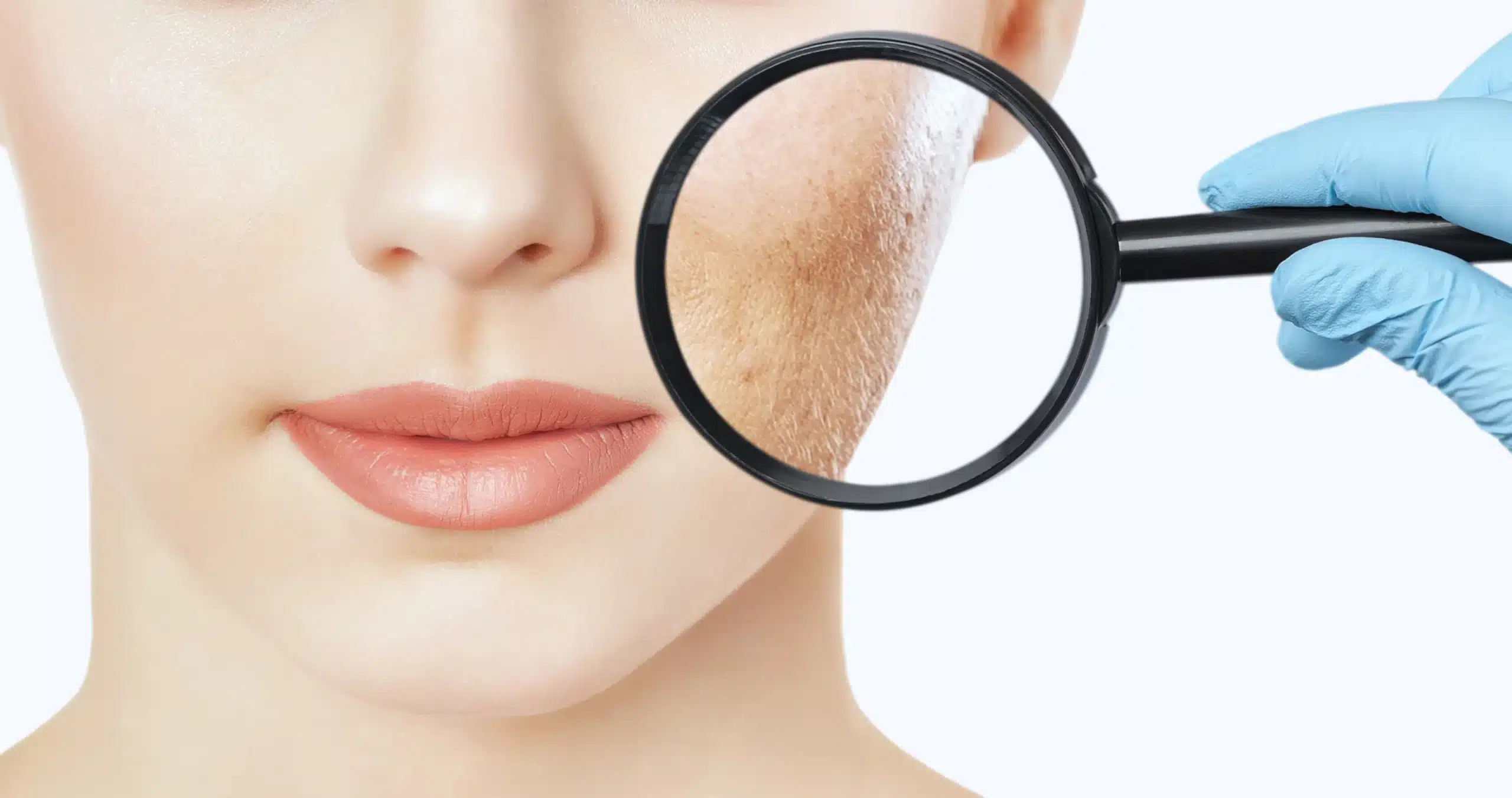
Fractional CO₂ laser is a fractional ablative laser using a wavelength of 10 600 nm, strongly absorbed by water in skin tissues. Its energy creates microscopic treatment columns called Microthermal Treatment Zones (MTZ). Within these columns, tissue is vaporised while neighbouring tissues remain intact.
This alternation between treated and healthy skin is the principle of fractional treatment. Untreated areas serve as a reservoir of cells, enabling faster healing and effective restoration of the skin barrier. Meanwhile, heat spreading into the dermis stimulates fibroblasts, the cells responsible for synthesising collagen, elastin and other components essential to skin quality.
The result therefore relies not only on superficial skin ablation, but also on genuine dermal remodelling that continues for several months after treatment.
The advantages of CO₂ laser in
fractional mode
Fractional CO₂ laser is particularly valued for :
- Its ability to treat several signs of ageing in one session : it improves overall skin quality rather than correcting a single concern.
- The good balance between effectiveness and recovery : fractional treatment limits the extent of skin injury, promotes faster healing and reduces complications when indications are correctly established.
- High precision : settings are adjusted to wrinkle depth, scar type, anatomical location and the patient's phototype.
- Continued improvement after the session : skin texture changes in the first weeks, while stimulation of collagen synthesis continues for several months, gradually improving firmness, suppleness and overall appearance.
Indications for CO₂ laser in
fractional mode
Fractional CO₂ laser is indicated to :
- Treat facial wrinkles and fine lines, particularly around the eyes and mouth.
- Improve photoageing and sun damage.
- Reduce atrophic acne scars.
- Improve certain surgical or traumatic scars.
- Reduce enlarged pores.
- Smooth uneven skin texture.
- Improve mild to moderate skin laxity.
- Treat stretch marks.
- Improve overall skin quality.
Which areas can be treated
with fractional CO₂ laser ?
Fractional CO₂ laser can be performed on several facial and body areas when skin quality or scarring justifies this treatment.
The areas most frequently treated are :
- The face, to improve overall skin appearance as part of skin rejuvenation.
- The eye area, to reduce fine lines and improve skin texture.
- The mouth area, to treat perioral wrinkles associated with ageing or smoking.
- The neck, when skin shows laxity or photoageing.
- The décolletage and hands, to improve age-related skin changes.
- Certain localised body scars when their appearance is suitable for fractional CO₂ laser treatment.
Contraindications
Fractional CO₂ laser is contraindicated or must be postponed in certain situations :
- Pregnancy or breastfeeding.
- An ongoing skin infection, particularly active herpes in the treatment area.
- Recent sun exposure or tanned skin.
- An active inflammatory skin condition in the area concerned.
A medical assessment is also essential for patients :
- With dark skin (higher phototypes), due to an increased risk of pigmentation disorders.
- With a history of hypertrophic scars or keloids.
- Taking photosensitising medication.
- Who have recently received systemic retinoids (isotretinoin or related medicines).

What happens during a fractional CO₂ laser session ?
Before the session
A preliminary consultation is essential to confirm the indication, check for contraindications and decide the treatment settings.
During the 2 to 4 weeks before the session, avoid significant sun exposure so the skin is not tanned. If there is a history of herpes, preventive antiviral treatment may be prescribed to limit reactivation.
What happens during the session
An anaesthetic cream is applied approximately one hour before the session. The laser beam is then swept across the skin in several passes, with intensity adapted to skin quality, lesion depth and the desired outcome.
The session generally lasts between 20 and 40 minutes, depending on the area treated.
After the session
A repair cream is applied immediately after treatment.
During healing, it is recommended to :
- Cleanse the skin with a gentle product.
- Apply a repairing, moisturising cream several times daily.
- Avoid exfoliating products and retinoids for 2 months.
- Protect the skin rigorously from the sun and avoid all sun exposure for 3 months.
How many sessions of CO₂ laser in
fractional mode are needed ?
The number of sessions is determined during the consultation and depends on the indication and treatment goals.
- Mild photorejuvenation : 1 to 3 sessions.
- Acne scars, deep wrinkles or longstanding lesions : 4 to 5 sessions.
Sessions are spaced 2 to 3 months apart to allow collagen to remodel between treatments.
After-effects
Recovery after fractional CO₂ laser varies with treatment depth.
After treatment, redness, slight swelling and a sensation of heat during the first hours are usual. Over the following days, the skin becomes drier before fine peeling occurs as part of natural skin renewal.
Recovery time depends on the depth of treatment. After light treatment, social activities can generally resume after 3 to 5 days. With more intensive treatment, healing generally takes between 7 and 10 days.
Possible side effects of fractional CO₂ laser
Fractional CO₂ laser may cause skin reactions after treatment. They are generally temporary and gradually diminish during healing.
The most frequent reactions are :
- Red, sensitive skin for several days.
- A sensation of heat, tingling or mild discomfort.
- Localised swelling, especially in thin-skinned areas.
- Small crusts or peeling during skin renewal.
In rare cases, complications can occur :
- Temporary or lasting changes in skin pigmentation.
- A recurrence of herpes in people carrying the virus.
- Infection of the treated area.
- Slower healing than expected.
Results of a fractional CO₂ laser session
Initial results are visible after healing. Skin gradually looks smoother and its texture more even. Improvement then continues for 3 to 6 months as collagen renews itself.
Fractional CO₂ laser can notably :
- Reduce wrinkles and fine lines.
- Improve the appearance of scars.
- Refine skin texture.
- Tighten enlarged pores.
- Improve skin firmness.
- Restore a more even appearance to the skin.
Findings from clinical studies on fractional CO₂ laser
- A review published in Lasers in Surgery and Medicine considers fractional CO₂ laser one of the most effective treatments for photorejuvenation, acne scars and skin remodelling, with an excellent balance between effectiveness and recovery time.
- A study published in Dermatologic Surgery shows significant improvement in acne scars after several fractional CO₂ laser sessions, with patient satisfaction increasing progressively throughout the sessions.
- Publications in the Journal of Cosmetic and Laser Therapy confirm that fractional treatment effectively stimulates collagen synthesis while reducing healing time compared with conventional ablative techniques.
- Recommendations published in JAMA Dermatology emphasise that personalised laser settings, phototype assessment and adherence to aftercare are essential to optimise results and limit complications.
Prices for a fractional CO₂ laser session
The price of a fractional CO₂ laser session depends on the treated area. Usual prices are :
- Full face : 900 CHF per session.
- Neck : 600 CHF per session.
- Décolletage : 1 000 CHF per session.
- Hands : 400 CHF per session.
- Small area (for example the eye area) : 400 CHF per session.
A personalised quotation is provided during the consultation, after clinical examination and confirmation of the indication.
Frequently asked questions about fractional CO₂ laser
What is the difference between CO₂ laser and fractional CO₂ laser ?
CO₂ laser refers to technology using a wavelength of 10 600 nm. Fractional CO₂ laser is a mode of using this technology in which only a fraction of the skin is treated to accelerate healing while maintaining excellent effectiveness.
When are results visible ?
Skin looks more even once healing is complete, but improvement continues for 3 to 6 months through gradual synthesis of new collagen.
Is treatment compatible with injections ?
Yes. Depending on the indication, fractional CO₂ laser can be combined with botulinum toxin or hyaluronic acid injections, Skinboosters or collagen stimulators as part of an overall rejuvenation strategy. Treatments are performed at two separate appointments.
Are results lasting ?
The benefits are lasting, but skin ageing continues naturally. Good sun protection and appropriate care prolong results.