Home » Skin enhancement » Improve the quality of the skin
La qualité de la peau repose sur plusieurs paramètres : son hydratation, sa fermeté, son élasticité, son épaisseur, son homogénéité, son éclat et la finesse de son grain. Avec l’âge, les expositions solaires, le tabac, la pollution ou certaines variations hormonales, la production de collagène, d’élastine et d’acide hyaluronique diminue progressivement. La peau devient alors plus terne, plus fine, ridée, moins souple et les pores, peuvent devenir plus visibles.
En médecine esthétique, améliorer la qualité de la peau ne consiste pas uniquement de corriger une ride ou un défaut isolé, mais d’agir sur l’ensemble des paramètres qui définissent une peau saine et belle : texture, éclat, hydratation, fermeté et homogénéité.
Une peau de bonne qualité reflète la lumière de manière uniforme, présente un grain fin, une bonne élasticité et un teint régulier.
L’objectif des traitements est de restaurer
Données clés sur l’amélioration de la qualité de la peau
Données issues des études cliniques sur l’amélioration de la qualité de la peau
Although the notion of beauty includes a degree of subjectivity, certain criteria make it possible to objectively assess skin quality. High-quality skin is characterized by several elements :
These parameters are interdependent. An alteration of one of them is enough to modify the overall appearance of the skin.
Over time and under the effect of external aggressions (sun, pollution, lifestyle), certain skin characteristics tend to deteriorate, which can be the source of aesthetic concern for many patients.
These signs may appear progressively and are often associated.
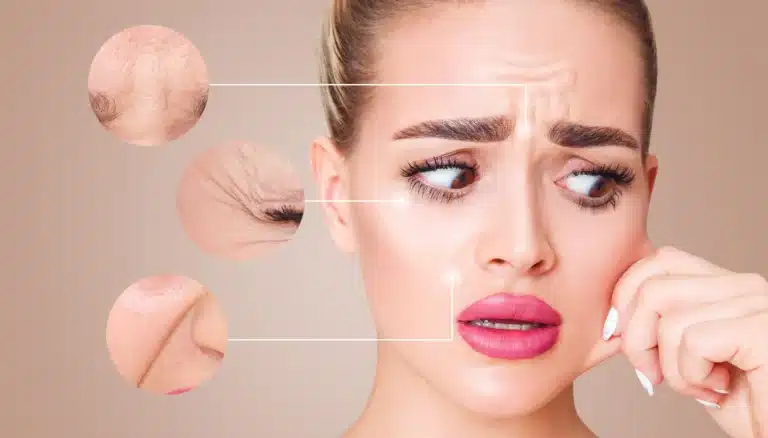
The deterioration of skin quality is multifactorial. It results from natural biological mechanisms, but also from environmental factors.
Improving skin quality is based on a global approach. It is rarely sufficient to treat a single parameter.
The techniques used are :
Skinboosters consist of injections of lightly cross-linked hyaluronic acid into the dermis.
They help hydrate the skin in a long-lasting way, improve its suppleness and smooth fine lines. The skin becomes more radiant and more even.
Sculptra works by stimulating the natural production of collagen. This treatment progressively improves skin density and firmness. It is particularly interesting for skin that is lax or thinned.
Mesotherapy helps hydrate the superficial layers of the skin through the injection of complexes rich in vitamins, hyaluronic acid and antioxidants. It improves radiance, suppleness and overall skin quality, while giving a fresher and more rested appearance.
Peels act in a complementary way. They help densify the skin, refine the skin texture and stimulate cell renewal. The complexion becomes more even, more luminous, with a real glow-boosting effect.
Medical lasers make it possible to act on radiance, texture and skin density at the same time.
The fractional ablative laser and the photorejuvenation laser stimulate collagen production and help densify the skin. They are particularly effective for improving skin texture, tightening pores and smoothing fine lines. These treatments provide a true skin renewal effect, with improved firmness and radiance.
More beautiful skin is skin that is better hydrated, more even, more radiant and better protected from the sun. An adapted routine and targeted medical treatments make it possible to visibly improve its texture and the radiance of the face.
Skin texture improves by stimulating skin renewal, hydration and collagen synthesis. Peels, fractional lasers, mesotherapy and certain biostimulation protocols are particularly useful when the skin is irregular or thickened.
Lack of radiance is often linked to dehydration, an uneven complexion, the accumulation of dead cells or photoaging. Mesotherapy, peels, photorejuvenation and Skinboosters are indicated to restore luminosity to the skin.
Dull skin may be linked to poor hydration, sun exposure, smoking, stress, lack of sleep or a slowdown in cell renewal. It then reflects light less well and appears more tired.
When the skin lacks water, cosmetic care alone is not always sufficient. In aesthetic-oriented medicine, mesotherapy and Skinboosters help deeply hydrate the skin and improve its suppleness, comfort and radiance.
There is no single treatment suitable for all patients. The best treatment depends on the dominant concern : dull complexion, enlarged pores, skin laxity, spots, dehydration or crepey skin. This is precisely the value of a personalized medical consultation.
Yes, Skinboosters are indicated when the skin lacks hydration, suppleness and radiance. They improve skin quality without modifying facial volumes. Their goal is to achieve fresher, smoother and more luminous skin.
Yes, Sculptra works by progressively stimulating collagen synthesis. It is particularly interesting when the skin has lost density and firmness. Its effect is gradual, diffuse and particularly useful for thinned or lax skin.
Mesotherapy is useful for hydrating the superficial layers of the skin and improving complexion radiance. It is well suited for dull, tired or dehydrated skin, particularly as part of regular maintenance.
Yes, peels improve skin texture, complexion and radiance. They promote cell renewal, refine skin texture and provide a particularly sought-after glow-boosting effect.
The choice of laser depends on the indication. The photorejuvenation laser is useful for radiance and complexion uniformity, while the fractional ablative laser is indicated to densify the skin, improve texture and stimulate collagen synthesis. This choice should be made after a clinical examination.
Skin firmness largely depends on collagen. Treatments that stimulate its production, such as Sculptra or certain lasers, are indicated when the skin becomes thinner, less dense or less firm.
Crepey skin often corresponds to a lack of hydration associated with a loss of density. Skinboosters, mesotherapy, biostimulation treatments and certain lasers help improve this aspect progressively.
It is entirely possible to improve skin radiance without surgery. The most commonly used treatments are mesotherapy, peels, Skinboosters and photorejuvenation lasers, depending on the skin’s needs.
There is no single age. Treatment mainly depends on the first observed signs : dehydration, dull complexion, visible pores, spots or loss of firmness. Early management often makes it possible to achieve simpler and more natural results.
Daily sun protection remains an essential measure to limit photoaging, spots and the degradation of skin texture. It should accompany all treatments aimed at sustainably improving skin quality.

