Which skin types is Glass Skin suitable for ?
Glass Skin can be achieved regardless of skin type, provided care is adapted to individual needs. Dry skin mainly requires barrier repair and deep hydration, while combination or oily skin needs sebum regulation and pore tightening. Sensitive or redness-prone skin requires gradual care focusing on reduced inflammation and even tone. Sensitive or redness-prone skin should be treated progressively, focusing on reducing inflammation and harmonising tone.
Unsuitable skincare – overly occlusive products on oily skin, irritating ingredients on fragile skin or excessively drying products on dehydrated skin – compromises results and may worsen imbalances.
Precise analysis of skin type and function therefore determines success, producing smoother, brighter and visibly more even skin.
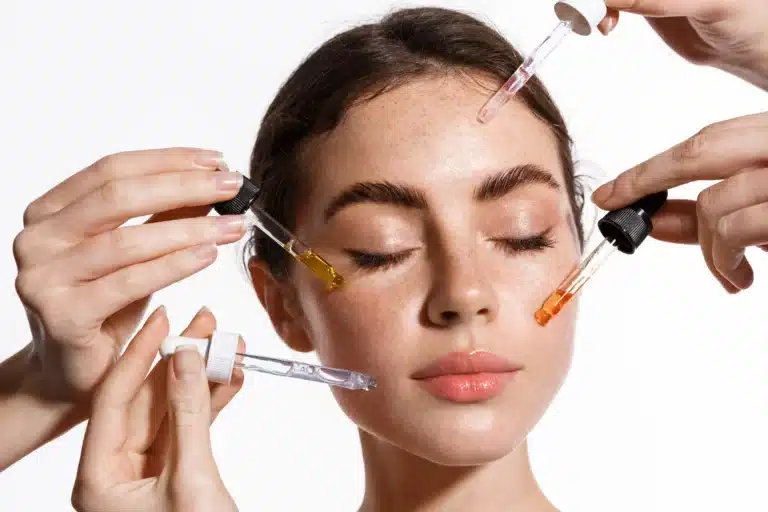
The biological foundations of Glass Skin : hydration, density, luminosity and transparency
Glass Skin rests on four fundamental biological parameters that together create perfectly smooth, even and radiant skin.
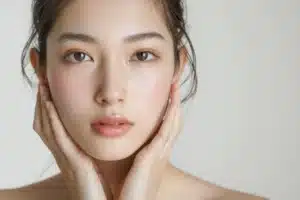
Above all, Glass Skin is deeply hydrated, luminous and visibly uniform. Its radiance depends on the precise balance between dermal hydration, stratum corneum quality, even pigmentation and absence of inflammation. Aesthetic medicine achieves this through a comprehensive approach targeting each mechanism.
- Deep hydration : the skin must contain sufficient water, supported particularly by naturally occurring hyaluronic acid. Hydration ensures tissue suppleness and contributes to Glass Skin's characteristic luminosity.
- Even skin quality : Glass Skin is smooth, with barely visible pores and balanced shedding. Fine roughness, superficial scars or enlarged pores disrupt light reflection.
- Uniform luminosity : the stratum corneum must reflect light evenly. Inflammation, dullness or skin lipid oxidation immediately impair this capacity and reduce natural radiance.
- Apparent transparency : an optical effect from even pigmentation, absence of diffuse redness and a perfectly uniform complexion.
In medical practice, these parameters are systematically assessed and treated together for coherent, natural and lasting results.
Medical indications for the Glass Skin protocol
Glass Skin is intended not only for patients wishing to improve aesthetic appearance ; it also addresses medical indications frequently encountered in Geneva.
It particularly suits chronically dehydrated skin, often seen with dry air exposure, substantial climate variations or prolonged unsuitable skincare. It is also relevant for dull skin weakened by oxidative stress, pollution or persistent micro-inflammation. Patients with enlarged pores, superficial acne scars or uneven texture also benefit significantly. Glass Skin is particularly appropriate in early laxity, when collagen and elastin production begins declining.
It is a comprehensive approach to restoring balanced, lasting skin physiology rather than an isolated surface treatment.

Achieving Glass Skin
Achieving Glass Skin requires simultaneous improvement in four essential parameters : deep hydration, even tone, regular texture and light reflection quality. Structured care addresses the barrier, microcirculation, dermal density and stratum corneum cohesion together. The protocol is never standardised : it follows a precise clinical examination and combines complementary techniques targeting specific biological mechanisms. The aim is not to “transform” skin, but restore optimal function for a smooth, even and radiant surface.
Deep hydration : Skinboosters and Sculptra
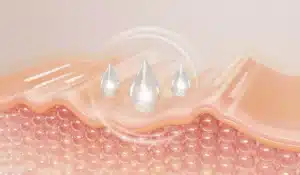
Deep hydration is the foundation of Glass Skin. Well-hydrated skin regains elasticity, suppleness and its natural ability to diffuse light evenly. Skinboosters, a lightly cross-linked hyaluronic acid, effectively restore dermal water content and immediately improve quality. They provide an internal water reservoir essential for smooth, dense and luminous skin.
Sculptra stimulates collagen production, strengthening dermal structure and improving tissue quality lastingly. Combining these techniques provides deep, stable and visible hydration, essential for a true Glass Skin effect.
Hydrafacial and PRX-T33 peel
Even texture is essential for true Glass Skin because it determines light reflection from the surface. Hydrafacial combines deep cleansing, controlled exfoliation and targeted active ingredient infusion to smooth the surface, reduce pore appearance and correct superficial irregularities. It prepares skin ideally and immediately improves softness.
The PRX-T33 peel stimulates renewal without visible peeling while evening skin quality. It reduces minor surface roughness and improves tired-looking skin. Combining both techniques provides the uniform texture essential to Glass Skin.
Luminosity : facial mesotherapy/mesolift
Glass Skin's uniform luminosity relies on well-nourished skin and effective microcirculation. Facial mesotherapy, or mesolift, acts directly in the dermis by delivering targeted vitamins, amino acids, non-cross-linked hyaluronic acid and trace elements. These reactivate natural radiance, correct oxidative stress-related dullness and improve cellular balance. Internal stimulation optimises stratum corneum quality and enables more even light reflection.
Mesotherapy is essential to achieving Glass Skin. Improving clarity and reviving radiance contribute to uniform, lasting luminosity. Skin regains freshness, vitality and transparency, essential to the desired smooth, radiant appearance.
Apparent transparency : peels and ablative laser
Glass Skin's apparent transparency depends on an even complexion without redness or pigmentation. Medical peels act on the superficial epidermis to correct mild pigmentation, refine texture and brighten dull areas. Removing dead cells that impair tone immediately improves clarity.
The ablative laser works more deeply, targeting stronger irregularities : resistant pigmentation, superficial scars, uneven texture or discolouration. Intensive tissue regeneration strengthens quality and promotes a clearer, more even appearance. Combining these techniques creates a clear, uniform and optically more transparent complexion, the signature of authentic Glass Skin.
How can Glass Skin be achieved naturally ?
Glass Skin can be approached naturally through simple habits : daily suitable moisturising, facial sun protection to prevent pigmentation and redness, and gentle home exfoliation once or twice weekly for a smoother surface. A regular, non-irritating routine, good hydration and a balanced lifestyle gradually improve radiance and evenness. These measures help, although they cannot equal medical treatments' more comprehensive effects.
Results
Glass Skin results are gradual but clearly noticeable from the first sessions. Deep hydration creates more supple, bouncy and visibly plumped skin. Quality improves, pores become less apparent and the surface becomes more even. Luminosity improves measurably : a clearer, more uniform complexion reflects light more evenly through a better-structured stratum corneum and stimulated microcirculation. Pigmentation irregularities gradually diminish, creating greater transparency. Medically, barrier function also improves, chronic micro-inflammation declines and dermal quality increases. Coordinated techniques provide an overall result : smoother, denser, more stable and lastingly radiant skin.
Glass Skin therefore aims at genuine improvement in skin health, with aesthetic benefits as a direct consequence.
Frequently asked questions about Glass Skin in Geneva
Which treatments achieve Glass Skin ?
Several techniques can be combined : Skinboosters, Sculptra, medical peels, Hydrafacial, PRX-T33 peel, facial mesotherapy and lasers according to needs. Each targets a specific aspect : hydration, texture, luminosity or even tone.
How many sessions are needed ?
The number varies with initial condition, but a complete protocol generally requires several sessions a few weeks apart. Maintenance then takes place once or twice yearly.
Are Glass Skin results immediate ?
Some effects, such as hydration and improved skin quality, appear quickly. Others, such as dermal density and even tone, develop gradually over successive sessions.
Does Glass Skin provide natural results ?
Yes. The aim is to restore skin function rather than alter facial volume. Results remain subtle, harmonious and adapted to each patient.
Does Glass Skin require social downtime ?
Most techniques require no social downtime. Some methods, such as ablative lasers, may need a few days' recovery.
How long do the results last ?
Duration depends on skin quality and maintenance. With regular follow-up, results last several months and can be sustained over time.
Can Glass Skin be achieved with cosmetic skincare alone ?
A regular routine improves radiance and quality but is generally insufficient for the Glass Skin effect. Medical treatments act deeply on quality, hydration and evenness.