Highlights
Hair loss treatment in Geneva
Alopecia, whether affecting women or men, is a common hair concern that often impacts quality of life.
The most common form is androgenetic alopecia, mainly caused by hormonal and genetic factors.
To reduce hair loss over the long term, treatments have
been developed to complement medication, where appropriate, such as Minoxidil and Finasteride.
Hair PRP, hair LED therapy and hair mesotherapy improve hair density and stimulate regrowth.
What can cause hair loss ?
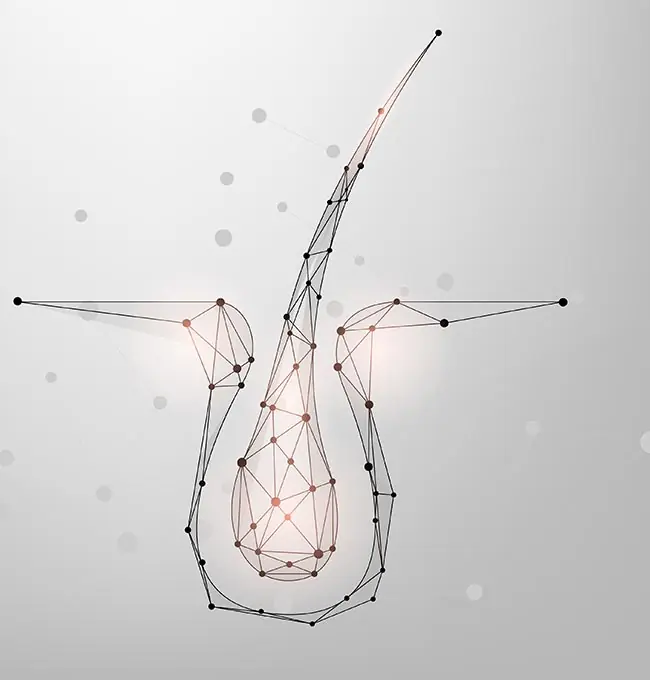
The hair cycle comprises three phases : the growth or anagen phase (85% of hairs are in this phase), the stabilisation or catagen phase (between 1 and 2% of hairs are in this phase), and the shedding or telogen phase (15% of hairs are in this phase).
During a dermatological scalp examination, analysing these phases is important to identify a possible cause.
Alopecia can be acute (lasting less than three months) or chronic (lasting more than three months), diffuse or localised.
Causes of acute alopecia include : stress, rapid weight loss, surgery, infection or acute haemorrhage, the postpartum period.
Causes of chronic alopecia include : deficiencies (particularly iron deficiency), endocrine disorders, traction alopecia, organ failure, particularly kidney failure.
The most common cause of alopecia is androgenetic alopecia.
The contraceptive pill and hair loss
Some contraceptives benefit the hair, while others weaken it and may cause alopecia.
How does contraception affect hair loss ?
Hormones are important for hair health. They influence its shine, strength and tendency to become dry and dull. Hormonal fluctuations can cause hormonal hair loss.
Hormonal contraception directly affects hair appearance. Hormone composition and dosage depend on the pill type. This is why some combined oestrogen-progestogen pills improve hair quality, while progestogen-only pills can cause deterioration.
Hair loss and heredity
Alopecia can be hereditary. The most common form is androgenetic alopecia, which mainly affects men. Contrary to what might be expected, it is not exclusively related to ageing and can develop from the age of 20. In men, this type generally begins with hair loss along the frontal hairline and temples.
Heredity plays a predominant role in androgenetic alopecia. However, hormones, particularly androgens, are also involved. Androgen receptors in the hair's dermal papilla disrupt the hair cycle : growth accelerates and hairs become increasingly fine before falling out permanently.
Why does hair loss occur during menopause ?
Hair loss during menopause is mainly due to the hormonal changes occurring at this time. Oestrogen and progesterone levels decline during menopause, disrupting hormonal balance. Declining female hormones lead to a relative increase in androgens, the male hormones, which can affect hair follicles.
Androgens reduce follicle size, slow hair growth and accelerate shedding.
Other factors, such as stress, nutritional deficiencies and certain medicines, can contribute to menopausal hair loss.
Hair loss during pregnancy
Hair loss after pregnancy, also called postpartum hair loss, is common. Around a third of women may be affected. This hair loss is hormonal, triggered by the changes occurring after childbirth.
During pregnancy, expectant mothers often notice improved hair quality, with shinier, silkier hair and better growth because of increased oestrogen levels.
After childbirth, the rapid decline in this hormone causes sometimes dramatic shedding, creating the impression of losing handfuls of hair.
Several other factors can aggravate postpartum hair loss : rapid weight loss, nutritional deficiencies, particularly iron deficiency, stress and tiredness.
Scarring alopecia
Scarring alopecia is a form of localised alopecia that is unfortunately permanent.
It can result from scalp inflammation or be caused by trauma, a burn or scalp radiotherapy.
Stress-related hair loss
This hair loss, also known as postpartum telogen effluvium, is caused by intense physical or emotional stress.
During stressful periods, a larger proportion of hairs prematurely enters the resting (telogen) phase and falls out a few months later.
The phenomenon is often temporary and reversible once the stressor is removed.
What is traction alopecia ?
Traction alopecia is caused by repeated, excessive tension on hair follicles.
It often results from tight hairstyles such as braids, buns and ponytails.
This constant tension damages follicles, causing progressive hair loss.
The first signs of traction alopecia are thinning hair and a receding frontal hairline. To prevent and treat this condition, reducing hair tension by avoiding tight hairstyles is recommended.
Androgenetic alopecia
The most common cause of alopecia is genetically determined androgenetic alopecia, in which hair loss results from androgen influence.
This type can affect men from 18 and women from their thirties.
It is referred to as male alopecia and female alopecia.
Two scales describe progression stages, the Hamilton scale for men and the Ludwig scale for women.


How can hair loss be prevented ?
The only true prevention is to treat the cause of hair loss. However, certain measures improve hair health :
- Use gentle, sulphate-free shampoos to avoid irritating the scalp.
- Limit chemical treatments (colouring, perms, straightening).
- Protect hair from external aggressors, particularly UV rays.
- Check for iron deficiency, often involved in hair loss.
How can hair loss be stopped ?
Hair loss in women and men is a common reason for consultation.
Although treatments can reduce hair loss over the long term, regrowth is unpredictable and never dramatic.
Certain medical techniques, used alone or together, help patients regain denser, stronger and healthier hair.
Before considering any treatment, identifying and correcting a possible cause of alopecia is essential.
Hair PRP : perfect hair in three months
From an aesthetic perspective, the reference method is PRP injections, particularly hair PRP.
No specific preparation is needed before the session. Dr Romano begins by assessing the scalp to identify the most vulnerable areas, although the whole scalp will be treated.
A blood sample is taken, then the tube is centrifuged for around six minutes to separate platelet-rich plasma (PRP) from the other blood components. PRP, concentrated in growth factors, is then collected and injected into the scalp using a mesotherapy gun, making the session virtually painless.
There are no particular after-effects, and daily activities can be resumed immediately. However, anti-inflammatory medicines or corticosteroids are discouraged for 48 hours after the session.
The initial protocol comprises three sessions spaced three months apart. An annual maintenance session is then recommended.


Hair mesotherapy : hair loss treatment
Hair mesotherapy involves injecting a mixture of vitamins, minerals, amino acids and other essential nutrients directly into the scalp. These ingredients stimulate hair follicles, improve local circulation and support cell regeneration. It also helps slow hair loss by strengthening follicles and prolonging their growth phase. Sessions are well tolerated when performed with a gun ; manual injections are more painful and less effective.
After the session, avoiding shampoo until the next day and activities causing significant scalp sweating on the same day is recommended.
The protocol comprises an initial and a maintenance phase. The initial phase includes six sessions two weeks apart, followed by three sessions one month apart. Maintenance then consists of one session every three to six months.
Hair loss treatment : LED hair therapy
LED (light-emitting diode) therapy is an innovative, non-invasive technique for treating alopecia with promising results. It uses specific wavelengths to stimulate hair follicles and support regrowth.
LED light improves blood circulation, increasing essential nutrient supply to hair follicles. It also helps reduce inflammation and oxidative stress, two factors often associated with hair loss. LED treatment is painless and requires no recovery time.
This treatment can be performed alone or alongside mesotherapy and PRP sessions.
Around twenty sessions are needed.

Before / after results of hair loss treatments
Results start becoming visible around three months after treatment begins because the hair cycle is long. Their extent varies according to individual response and the method used.
LED improves scalp circulation, reduces inflammation and oxidative stress, and stimulates hair follicles. It can slightly increase hair density and quality, but regrowth remains very limited.
Mesotherapy strengthens follicles and prolongs their growth phase by directly supplying essential nutrients. It improves hair quality, making hair thicker and stronger. It also reduces shedding, but regrowth rates remain low.
PRP stimulates tissue regeneration and improves follicle health through growth factors. It reduces shedding, helps thicken existing hair and can trigger new regrowth cycles, with rates varying between patients.
Hair loss treatment in Geneva : prices
In Geneva, medical hair loss treatments are offered at prices varying according to the technique used. PRP (Platelet-Rich Plasma), often indicated for its targeted effect on hair density, costs CHF 600 per session. Hair mesotherapy, also called mesohair, costs CHF 200 per session. These prices apply to each session, and the number needed depends on the type of hair loss, each patient's circumstances and the treatment strategy adopted.
Reviews of treatments for hair loss
Patients report a clear improvement in hair quality and density, accompanied by renewed confidence. They appreciate the non-invasive treatments and absence of downtime. Many highlight that combining techniques produces better results, provided follow-up is consistent. However, as with any medical treatment, responses vary between individuals, requiring a personalised medical assessment.
Data from fourteen studies of PRP for androgenetic alopecia show an increase in hair density compared with placebo. The quantitative analysis found an average gain of around 28 hairs per cm². Protocols varied considerably and certainty of the evidence was low: this average does not predict an individual result.
Nine trials involving 238 patients found an improvement in hair density at three and six months after PRP compared with placebo. However, superiority was not demonstrated for all measures, particularly hair diameter. These results concern androgenetic alopecia and should not be extended to every cause of hair loss.
A synthesis of 27 controlled trials assesses the effects of platelet-rich plasma (PRP) on different forms of hair loss. Results show an increase in hair density compared with saline injections. However, differences between the studies limit the strength of this conclusion. The data should also be considered separately for androgenetic alopecia and alopecia areata, because the evidence of effectiveness differs between these conditions.
Frequently asked questions about hair loss treatment in Geneva
What is the best treatment for alopecia ?
The best treatment is determined according to the cause and severity of alopecia and the patient's sex. A specialist consultation will identify the most suitable treatment.
Does hair regrow after 60 ?
Yes, hair can regrow after 60, although density and regrowth speed decrease. Treatments such as PRP, mesotherapy and LED therapy stimulate regrowth.
What is the best hair loss product for women ?
Products containing Minoxidil are often recommended for women. Natural solutions such as essential oils and dietary supplements are complementary.
Does hair regrow after alopecia ?
Yes, hair can regrow after alopecia, especially when treated promptly and effectively, but regrowth is impossible in scarring alopecia.
Which plant can replace Minoxidil ?
Plants such as saw palmetto (dwarf palm) are sometimes used as natural alternatives to minoxidil to slow hair loss. Minoxidil remains more effective than a plant.
How can androgenetic alopecia be stopped ?
Androgenetic alopecia can be slowed with treatments such as Minoxidil, Finasteride (in men), LED therapy, mesotherapy and PRP. A healthy lifestyle and balanced diet are also important.
How can alopecia in women be concealed ?
Cosmetic solutions such as hair powders, wigs, extensions or specific hairstyles can be used.
Is alopecia irreversible ?
Some forms of alopecia, such as scarring alopecia, are irreversible. However, other types, such as androgenetic alopecia or alopecia areata, can be treated.
How can menopausal hair loss be stopped ?
Hair loss during menopause can be slowed with hormonal treatments, dietary supplements rich in vitamins and minerals, and topical treatments such as Minoxidil.
How can alopecia be slowed ?
To slow alopecia, appropriate treatment must be followed : Minoxidil, PRP and mesotherapy. A healthy lifestyle, balanced diet and stress reduction are also beneficial.
Does Minoxidil really work ?
Yes, Minoxidil is clinically proven to effectively treat hair loss and stimulate regrowth.
What are the disadvantages of Minoxidil ?
Possible side effects of Minoxidil are : scalp irritation, itching, facial and hand hair growth and, rarely, palpitations.
How can fine hair be thickened ?
Rosemary essential oil is recognised for stimulating hair regrowth. Peppermint essential oil and lavender oil are also beneficial.
How can fine hair be thickened during menopause ?
Mesotherapy, PRP and Minoxidil effectively thicken fine hair during menopause. A diet rich in protein and vitamins is recommended.
Which blood tests are needed for hair loss ?
Blood tests for hair loss should measure iron, ferritin, vitamin D, vitamin B12, zinc, thyroid hormones and androgens.
When should hair loss cause concern ?
When daily shedding exceeds physiological loss, meaning 50-100 hairs a day, it is time to consult a doctor. Concerning signs include reduced hair density, bald patches, itching or scalp irritation.
How can female alopecia be treated naturally ?
Certain habits benefit the scalp but cannot treat alopecia : scalp massage, applying essential oils to the scalp, dietary supplements and a healthy diet.
How can hair volume be restored ?
Diet : foods rich in protein, vitamins (biotin, vitamins A, C, D, E) and minerals (iron, zinc, selenium), and good hydration.
Haircare : gentle hair products without sulphates, parabens or silicones. Avoid excessive heat (hairdryers, straighteners) and overly tight hairstyles.
Medical treatments when prescribed : Minoxidil and Finasteride.
Natural remedies : essential oils such as rosemary oil.
Dietary supplements containing biotin and vitamins.
Hair PRP, hair mesotherapy, LED.
Stress management.