Home » Solutions » Lasers and devices » Fractional CO₂ laser
Fractional CO₂ laser is an aesthetic medicine treatment designed to provide long-lasting improvement in skin quality, correct the signs of ageing, and treat certain scars without surgery. Unlike older resurfacing techniques that treated the entire skin surface, the fractional CO₂ laser delivers its energy as thousands of microscopic impacts distributed evenly across the treatment area. This technology treats only a fraction of the skin while leaving areas of intact tissue between each impact, which are essential for rapid healing.
This approach has profoundly transformed skin resurfacing. It combines high efficacy in treating wrinkles, scars and photoaging with a recovery period that is generally shorter than that associated with traditional ablative lasers. The treatment simultaneously improves skin texture, enlarged pores, fine lines and loss of firmness through the progressive stimulation of collagen synthesis.
The fractional CO₂ laser is a fractional ablative laser that uses a wavelength of 10,600 nm, which is highly absorbed by the water present in skin tissues. Its energy creates microscopic treatment columns known as Microthermal Treatment Zones (MTZ). Within these columns, the tissue is vaporised while the surrounding tissues remain intact.
This alternation between treated skin and healthy skin is the fundamental principle of fractional treatment. The untreated areas act as reservoirs of cells, allowing faster healing and effective restoration of the skin barrier. At the same time, the heat diffused into the dermis stimulates fibroblasts, the cells responsible for the synthesis of collagen, elastin and other essential components of skin quality.
The result therefore relies not only on the superficial ablation of the skin, but also on genuine dermal remodelling that continues for several months after the session.
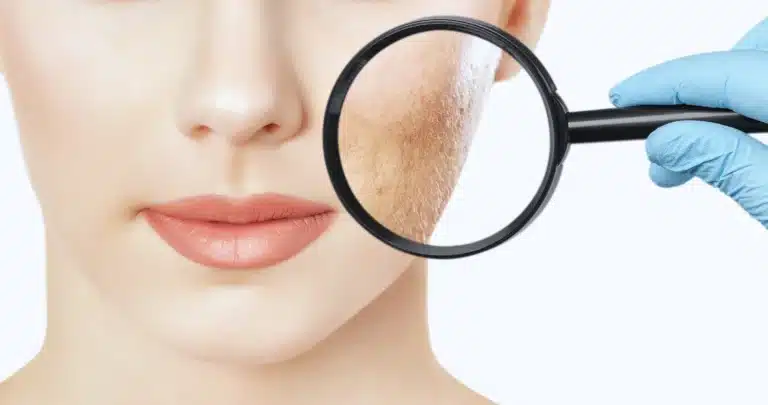
Fractional CO₂ laser is particularly valued for :
Fractional CO₂ laser is indicated for :
The fractional CO₂ laser can be performed on several areas of the face and body when the quality of the skin or the presence of scars justifies this type of treatment.
The most frequently treated areas are :

Fractional CO₂ laser is contraindicated or should be postponed in certain situations :
A medical assessment is also essential for patients :
A preliminary consultation is essential to confirm the indication, identify any possible contraindications, and determine the treatment parameters.
During the 2 to 4 weeks before the session, it is essential to avoid significant sun exposure so that the skin is not tanned. In the event of a history of herpes, preventive antiviral treatment may be prescribed to reduce the risk of reactivation.
A topical anaesthetic cream is applied approximately one hour before the session. The laser beam is then passed over the skin in several passes, the intensity of which is adjusted according to the quality of the skin, the depth of the lesions, and the desired objectives.
The session generally lasts between 20 and 40 minutes, depending on the area being treated.
A repairing cream is applied immediately after the treatment.
During the healing phase, it is recommended to :

The number of sessions is determined during the consultation and depends on the indication and the treatment objectives.
Sessions are spaced 2 to 3 months apart to allow collagen time to remodel between each treatment.
The recovery following fractional CO₂ laser treatment varies according to the depth of the treatment performed.
After the treatment, it is common to experience redness, slight swelling of the skin, and a sensation of heat during the first few hours. Over the following days, the skin becomes drier before developing a fine peeling, corresponding to the natural process of skin renewal.
The recovery time depends on the depth of the treatment performed. After a light treatment, social activities can generally be resumed after 3 to 5 days. When the treatment is more intensive, the healing phase generally lasts between 7 and 10 days.
Fractional CO₂ laser treatment may cause skin reactions after the session. These are generally temporary and gradually subside during the healing process.
The most common reactions are :
In rare cases, complications may occur :
The first results become visible after healing. The skin gradually appears smoother, and the skin texture becomes more even. Improvement then continues over the following 3 to 6 months, as collagen renews itself.
The fractional CO₂ laser notably makes it possible to :
The cost of a fractional CO₂ laser session depends on the area being treated. The fees usually charged are as follows :
A personalised quotation is provided during the consultation, after the clinical examination and confirmation of the indication.
The CO₂ laser refers to the technology that uses a wavelength of 10,600 nm. Fractional CO₂ laser refers to a mode of using this technology in which only a fraction of the skin is treated, in order to speed up healing while maintaining excellent efficacy.
The skin appears more even as soon as healing is complete, but improvement continues for 3 to 6 months thanks to the gradual synthesis of new collagen.
Yes. Depending on the indication, fractional CO₂ laser can be combined with botulinum toxin injections, hyaluronic acid injections, Skinboosters, or collagen stimulators as part of a comprehensive rejuvenation strategy. The treatments will be carried out during two separate appointments.
The benefits are long-lasting, but the skin’s ageing process continues naturally. Good sun protection and appropriate maintenance help prolong the results.

