How do acne scars form ?
Acne scars generally develop after an inflammatory skin lesion, such as a spot. When inflammation is severe or poorly managed, skin integrity is damaged. This trauma can be aggravated by mechanical manipulation, particularly squeezing, piercing or scratching the spot.
Once the skin is damaged, the body initiates two mechanisms : an inflammatory response to eliminate microorganisms and a repair process to rebuild damaged skin tissues. Ideally, this healing phase allows the skin to regenerate correctly.
However, inflammation can persist even after the blemish disappears. In these situations, the skin heals unevenly, leaving a permanent mark : an acne scar. This reflects difficulty repairing the tissue correctly, either through excess fibrous tissue or volume loss.

Types of acne scars
Not all acne scars look alike. They may be small, deep, raised, pigmented or simply red. Understanding their shape helps select the most suitable treatment to improve the skin. Some are easy to reduce, while others require an experienced doctor.
- Ice-pick scar : these scars are very narrow and deep, resembling a small, pointed V-shaped hole. They often follow a severely inflamed spot. They are difficult to correct because they extend very deeply into the skin.
- Rounded scar : these scars are round or oval. They may be superficial or deeper. They sometimes create slightly undulating skin.
- Square-shaped scar (boxcar) : these scars have sharper edges and appear almost square or rectangular. They are visible because their contours are well defined.
- Hypertrophic scar : the skin forms a raised area, like a small growth, because of excessive collagen production during healing. These scars may be slightly thick or firm to the touch.
- Atrophic scar : this type resembles a small crater. The skin lacks collagen and has not fully rebuilt itself.
- Red inflammatory scar : these scars are neither depressed nor raised. They are smooth but remain red after the spot disappears. They represent prolonged skin inflammation.
How can acne scars be prevented ?
To prevent acne scars, good habits should begin as soon as spots appear. Most importantly, do not touch, pierce or scratch lesions. Manipulation risks introducing bacteria from the hands, potentially causing infection. An infected lesion triggers intense inflammation that encourages new spots and prolongs irritation in the same place. The longer skin remains inflamed, the harder it heals and the greater the scarring risk.
Sun exposure should also be limited. Although UV temporarily improves acne, this is followed by worsening. Many acne treatments also make skin sun-sensitive, potentially causing pigmentation spots. Healing spots are very sensitive. Sun exposure can darken the skin and leave a long-lasting mark. Protecting the skin and avoiding prolonged sun exposure is therefore important to limit visible scars.
How can acne scars be removed ?
Several aesthetic medical treatments can be offered to reduce or remove acne scars according to scar and skin type.
Medium-depth or deep peels support skin renewal and improve scars by stimulating regeneration.
Continuous ablative laser smooths scars by vaporising damaged skin layers.
Fractional laser creates controlled micro-ablation zones, stimulating regeneration and collagen production and gradually improving skin quality.
Skinboosters are indicated to hydrate skin and increase its density.
During an initial consultation, Dr Romano assesses the skin and acne scar type and proposes the treatment best suited to each patient.

Facial peels for acne scars
A medium-depth peel reduces acne scars through controlled exfoliation of skin layers. By removing part of the epidermis and dermis, it supports skin renewal, stimulates collagen production and gradually improves atrophic scars. This treatment is particularly effective for superficial to moderate scars and can be repeated according to skin thickness and individual tolerance. TCA peel concentration is determined by the desired depth, phototype and skin quality. Particular attention must be paid to aftercare and strict sun protection to minimise hyperpigmentation risk. A prior medical assessment is essential to define the appropriate concentration and depth while ensuring safety. One session is generally sufficient, although a second may sometimes be considered.
Skinboosters for acne scars
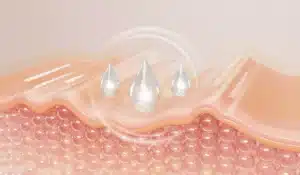
Skinboosters are lightly cross-linked hyaluronic acid injections designed to improve overall skin quality. For atrophic acne scars, their role goes beyond conventional filling. They deeply hydrate the dermis while supporting skin elasticity and suppleness. This restructuring reduces the visibility of some superficial scars and may enhance other treatments, such as lasers or peels.
This treatment is particularly indicated for uneven skin density, persistent dryness or lack of firmness. When performed with appropriate asepsis and injection techniques, it is generally well tolerated and causes no downtime. A medical consultation is essential to assess indications and identify optimal treatment areas.
Laser for acne scars
Ablative lasers improve atrophic acne scars through controlled ablation of skin tissues.
Continuous ablative lasers, such as CO₂ or Erbium, uniformly remove a skin layer in the treated area, at a depth adapted to the scar and skin type. This softens scar edges, restructures underlying tissues and stimulates synthesis of denser, better-organised new skin. This laser is particularly indicated for deep or extensive scars, but causes prolonged healing and an increased risk of erythema, scabs or pigmentation disorders.
Fractional ablative laser works differently : rather than treating the entire skin surface, it creates microcolumns of ablation or coagulation interspersed with intact skin. These untreated areas facilitate healing, also support collagen production and reduce complication risks compared with continuous laser treatment. Fractional mode is therefore most often used for moderate scars or to limit downtime.
Laser choice depends on factors such as scar type (rolling, ice-pick or boxcar), skin thickness, phototype and acceptable recovery time. Ablative lasers must be used cautiously on higher phototypes because of increased post-inflammatory pigmentation risk. Strict sun protection is essential throughout healing.
Areas that can be treated with laser
Acne scars can occur on various body areas : the face, neck, back, chest or shoulders. Of these, the face and neck are most commonly affected because their high concentration of sebaceous glands increases sebum production and inflammatory blemishes. Laser can be used on all these regions without limitation. It treats different scar types : atrophic, raised or pigmented. Laser stimulates collagen production and natural, gradual skin regeneration. Treatment is adjusted to each area's characteristics by precisely modulating intensity according to scar depth and skin sensitivity.
Benefits of laser treatment for acne scars
Laser significantly improves skin quality. By removing damaged tissue and stimulating collagen production, it helps increase firmness, elasticity and evenness. Scars fade as skin texture becomes visibly more uniform. Results are lasting, with significantly reduced scars and noticeably smoother skin. Every treatment is fully adapted to individual needs : intensity, treatment depth and session duration are adjusted according to scar characteristics, severity and skin type. Before any procedure, a detailed assessment defines the most appropriate strategy and optimal laser settings while minimising side-effect risks. Personalised follow-up and skincare advice are then provided.

What is the best treatment for acne scars ?
Medium-depth or deep peels and continuous ablative laser are the most effective solutions for acne scars.
However, these treatments are not suitable for everyone. Darker skin, from phototype IV, has an increased risk of post-inflammatory hyperpigmentation, making it a contraindication to these procedures.
Recovery time must also be considered : deep peels and ablative laser cause 7 to 10 days of downtime, which may be difficult for patients with significant professional or social commitments.
Can acne scars be completely eliminated ?
Atrophic acne scars do not disappear completely, but current treatments can produce significant improvement. Studies in Dermatologic Surgery, JAAD and Lasers in Surgery and Medicine indicate that resurfacing techniques – particularly ablative lasers, fractional lasers and certain medium-depth to deep peels – offer partial but clinically meaningful reductions in scar depth and visibility on average. Improvement varies according to scar type, skin quality and treatment : boxcar and rolling scars respond better than ice-pick scars, recognised as the hardest to treat. Literature also shows the best results come from combined protocols, integrating resurfacing with skin quality optimisation (such as Skinboosters). Smoother, more even skin is therefore generally possible, but complete scar removal is not.
How long will removing acne scars take ?
Acne scar improvement is gradual and generally takes several months. After resurfacing (ablative laser, fractional laser or medium-depth/deep peel), skin regeneration and collagen production continue for 3 to 6 months, explaining why results are not immediate. Depending on scar depth and technique, several sessions may be needed. Sessions are spaced 4 to 8 weeks apart. Superficial scars improve faster, while deep scars often require combined protocols for a satisfactory result. Acne scar management should therefore be regarded as a medium-term treatment, progressing according to skin biology, scar type and the chosen treatment plan.
Is acne scar treatment really effective ?
Acne scar treatments have been extensively published in medical journals such as Dermatologic Surgery, Lasers in Surgery and Medicine, Journal of the American Academy of Dermatology (JAAD) and Aesthetic Surgery Journal. Available evidence indicates that resurfacing techniques — particularly ablative laser, fractional laser and medium-depth to deep peels — achieve the most significant improvements in atrophic scars.
Articles in these journals generally show moderate to substantial reductions in scar depth and visibility, with clinical improvement after one treatment, enhanced by further sessions when indicated. Fractional ablative lasers are particularly well documented : studies report gradual improvement in skin quality and collagen production over several months through skin regeneration.
Medium-depth or deep TCA peels, long described in dermatological literature, have also demonstrated effectiveness in reducing superficial to moderate scars. Their ability to smooth skin and even the complexion is well described, but use requires careful phototype selection because of pigmentation risks.
Skinbooster injections do not directly change deep scar structure, but several aesthetic medical studies show measurable improvement in skin hydration, elasticity and quality, potentially making superficial scars less visible and optimising another treatment's results (laser or peel).
Medical literature also emphasises that treatment selection must be personalised, considering scar type, skin thickness, phototype and recovery time. The best improvements generally result from a combined approach integrating resurfacing and skin quality optimisation.
What is the average cost of laser treatment for acne scars ?
Acne scar treatment costs vary according to case complexity and treatment area. A medium-depth peel or continuous ablative laser generally requires one session, starting at CHF 500. Fractional ablative laser requires several sessions – averaging 4 to 6, around two months apart – starting at CHF 350 per session. Skinboosters can complement treatment to improve skin quality : a syringe costs CHF 400, with an average of two to three syringes annually, injected during the same session.
Is laser treatment for acne scars reimbursed ?
In Switzerland, laser treatment for acne scars is considered aesthetic medicine. It is therefore not reimbursed by basic insurance (LAMal), as it is an aesthetic procedure rather than medically necessary treatment. Supplementary insurance rarely covers this procedure, except in very specific cases involving post-traumatic scars or a reconstructive indication. Most patients therefore pay the full treatment cost themselves.
An analysis of 56 trials involving 1,488 patients compares treatments for atrophic acne scars. Several combinations using fractional CO₂ laser, particularly with subcision or PRP, show favourable results. Scar morphology and skin phototype remain decisive in selecting techniques, without guaranteeing complete disappearance.
Data from eight studies involving 418 patients compare fractional CO₂ and Er:YAG lasers for acne scars. Overall analysis found greater improvement with CO₂, with differences in pain and duration of redness. These results allow discussion of the intended benefit and the recovery associated with each technology.
Recent clinical publications report improvements in acne scars with different lasers and other energy-based skin treatment devices. Ablative lasers generally allow a greater correction, but require a longer healing period. Treatment selection depends on scar type, the desired result and the recovery time the patient can allow. Other techniques can be combined with laser to complement the correction.
Frequently asked questions about acne scars in Geneva
Are acne scar treatments suitable for all skin types ?
Medium-depth peels and continuous ablative lasers are contraindicated for higher phototypes (from phototype IV).
Is there downtime after acne scar treatment ?
Yes, for medium-depth peels and continuous ablative lasers (7 to 10 days). Fractional laser allows quicker recovery, often within a few days.
Can Skinboosters help ?
Yes, they improve skin hydration, elasticity and quality, making superficial scars less visible and enhancing other treatment results.