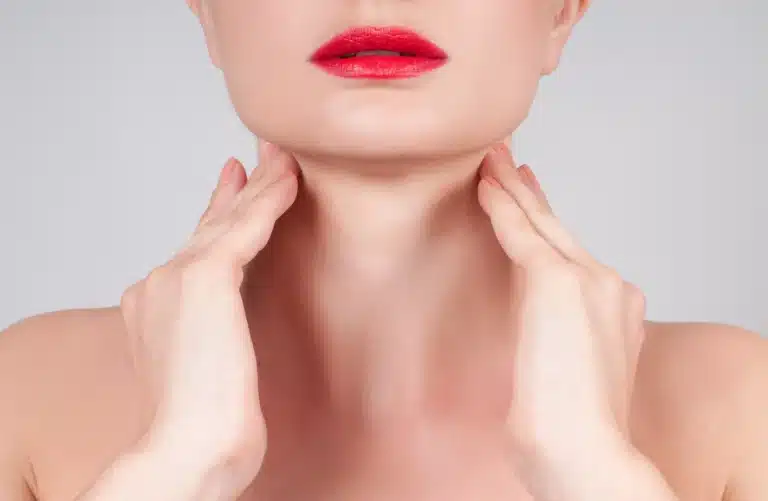
The different types of pigmentation marks on the décolletage
Brown spots on the décolletage do not all have the same cause or appearance. Solar lentigines are the most common : linked to repeated sun exposure, they appear as small, clearly defined brown spots, isolated or scattered. Diffuse hyperpigmentation mainly affects repeatedly exposed skin and appears as broad, irregular or mottled pigmented areas. In some cases, deeper spots may be linked to hormonal changes, particularly after menopause when the skin regulates melanin production less effectively. Identifying the type of pigmentation is essential because not all types respond to treatment in the same way, and the strategy must be adapted to their cause and depth.
How can the development of
spots on the décolletage be prevented ?
Prevention remains the first step in limiting brown spots on the décolletage. Daily sun protection is essential, even outside summer, because UVA rays pass through clouds and glass and are the main cause of chronic hyperpigmentation. Regular use of broad-spectrum sunscreen, combined with good hydration, helps curb excessive melanocyte stimulation.
Wearing covering clothing during prolonged exposure and adopting a skin-conscious lifestyle, particularly by limiting smoking and exposure to pollution, also help slow ageing of the cells producing the pigment that forms spots. These measures do not remove existing spots.
How can spots be removed from
the décolletage ?
Several aesthetic medicine solutions can be considered to treat or reduce pigmentation marks on the décolletage, depending on their type, depth and the overall condition of the skin. Depigmenting peels, photorejuvenation laser, fractional laser, regenerative mesotherapy or combined protocols can improve complexion clarity.
The aim is not only to erase existing spots, but also to prevent them returning. Treatments therefore improve skin quality, regulate pigmentation and provide lasting protection for the décolletage against the effects of the sun. Care is tailored to each patient's skin.
Depigmenting peel
A depigmenting peel is often indicated to reduce superficial or moderate brown spots on the décolletage. It involves applying a solution containing exfoliating acids such as glycolic acid or trichloroacetic acid to promote the removal of pigmented cells and stimulate skin renewal. On the décolletage, the concentration must be adapted to the thinness and sensitivity of the skin. The peel acts gradually, smoothing the skin surface, reducing pigmentation irregularities and improving skin radiance.
Several sessions spaced a few weeks apart are required.


Laser to eliminate
décolletage pigmentation
For deeper pigmentation marks, particularly when accompanied by crepey skin or loss of firmness, fractional ablative laser may be particularly indicated. It creates microscopic ablation channels in the dermis, triggering a natural skin repair process and stimulating collagen production.
This technique removes pigment and stimulates collagen synthesis, improving both the colour and density of décolletage skin. It is suitable for more advanced skin ageing, where spots coexist with fine lines, thinning skin or mild to moderate laxity. Depending on the intensity of the settings used, a short recovery period, generally a few days, may be needed while the skin regenerates.
The number of sessions depends on the skin's condition. Most often, two to three sessions spaced two months apart are required.
Which solution should be chosen to get rid of spots on the décolletage ?
No solution can permanently eliminate pigmentation marks on the décolletage. Their appearance is linked to deep, persistent mechanisms : skin ageing, repeated sun exposure, oxidative stress, hormonal changes and melanocyte activation. Even after effective treatment, the skin retains a “pigment memory”, meaning it remains sensitive to triggering factors and may develop spots again.
Lasers and peels can lighten spots, even the complexion and improve skin quality, but they do not prevent recurrence if sun exposure, insufficient protection or skin ageing continue.
The best approach is therefore to treat, then prevent. Daily sun protection, moisturising skincare and antioxidants, along with maintenance sessions (aesthetic treatments) once or twice a year help stabilise results and maintain more even, radiant skin.
Treatments are effective, but their benefit relies on follow-up and prevention rather than a promise of permanent disappearance.
A study involving 135 patients assessed intense pulsed light for treating poikiloderma of Civatte of the neck and upper décolletage, a condition combining pigmentation and small visible blood vessels. After one to five sessions, the authors reported a reduction of more than 75% in the pigmentary and vascular components. An improvement in skin texture was also observed in several cases. These results concern this particular combination of pigmentation and redness, after confirmation of the diagnosis.
A study involving 175 patients with poikiloderma of Civatte of the neck and décolletage assessed three intense pulsed light sessions, three weeks apart. Three months after the last session, comparison of photographs showed a reduction of more than 80% in the pigmentary and vascular components. These results highlight the value of this technique when décolletage spots are associated with redness and small visible blood vessels. The patients studied had skin phototypes I to III.
A prospective study involving 24 women assessed four sessions of non-ablative fractional laser at 1,440 and 1,927 nm for sun-related changes to the neck and décolletage. In the 20 participants who completed follow-up, assessments showed a significant reduction in pigmentation irregularities three months after the last session, alongside improvements in skin texture and wrinkles. This approach can address several signs of photoageing within the same treatment programme, according to the protocol studied.
Do brown spots on the décolletage disappear on their own ?
No, once established, pigmentation marks do not disappear spontaneously. They are linked to melanin accumulation in the epidermis and require targeted treatment, such as laser or a peel, depending on their type and depth.
What is the best treatment for removing spots on the décolletage ?
There is no standard treatment; everything depends on the type of spots and skin quality.
Are the results permanent ?
Spots can be significantly reduced or sometimes disappear, but no treatment guarantees a permanent result.
How many sessions are needed to treat pigmentation marks ?
The number of sessions depends on the method used, the depth of the spots and skin quality. On average, two to three laser or peel sessions are needed, sometimes followed by maintenance once or twice a year to sustain results.
Should sun exposure be avoided after pigmentation treatment ?
Yes, sun protection is essential after any treatment. Unprotected exposure can reactivate pigmentation, cause new spots or reduce treatment effectiveness. Daily sunscreen is recommended, even in winter.
When should I seek advice about pigmentation marks on the décolletage ?
A consultation is recommended as soon as the spots become a concern.