Home » Solutions » Injections » PRP hair loss
The PRP (Platelet-Rich Plasma) hair treatment is an innovative approach to stimulate hair regrowth, slow hair loss and improve scalp quality. Using the natural regenerative properties contained in the patient’s own blood, PRP hair is an autologous treatment that carries no risk of rejection or allergic reaction. This technique is appreciated for its effectiveness, safety and natural character. It is suitable for both men and women presenting diffuse alopecia, progressive thinning or a weakened scalp. The principle relies on the concentration of growth factors which, once injected into the scalp, stimulate the stem cells of the hair follicles and prolong the hair’s growth phase. The results include improved local vascularisation and reduced hair loss, as well as denser, thicker and more resistant hair.
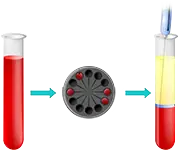
Platelet-rich plasma is a fraction of the blood obtained after centrifugation, which makes it possible to isolate platelets from the other blood elements. These platelets contain growth factors such as PDGF, VEGF, TGF and EGF, whose stimulating properties act on tissue regeneration. In the context of hair treatment, these growth factors activate stem cells at the level of the hair bulb, improve scalp vascularisation and prolong the anagen phase, that is, the growth phase of the hair. The follicle, better oxygenated and more active, produces thicker and stronger hair. PRP, through its anti-inflammatory action, also helps purify the scalp and improve its biological balance, which further strengthens the effectiveness of the treatment on regrowth. The beneficial effects develop progressively, session after session, and last for several months.
PRP hair is particularly indicated in cases of moderate to medium hair loss, when the follicles are still present but have become inactive or weakened.
It is especially suitable for male or female androgenetic alopecia, whether combined with other treatments or used alone.
In women, it is effective for hormonal or postpartum diffuse alopecia.
In men, it can stabilise hair loss and stimulate visible regrowth, especially when treatment is started early.
PRP is also used in cases of telogen effluvium, a reactive hair loss due to stress, fatigue, deficiency or illness, when the loss is diffuse but reversible. It is also useful as a complement to a hair transplant, to optimise graft survival and accelerate scalp healing. Note that PRP does not act on areas devoid of follicles.
After the initial consultation, the patient is comfortably seated. A blood sample is taken, usually from a vein in the arm, as in a standard blood draw. The tube containing the patient’s blood is placed in a centrifuge that separates the blood components and allows the platelet-rich plasma to be obtained. Once the PRP is prepared, it is injected into the scalp using fine needles or a mesotherapy device. Dr Romano uses a mesotherapy gun. The injections are distributed over the areas affected by hair loss or thinning.
The procedure is not very painful and is well tolerated ; sometimes a numbing cream is applied. The session lasts between 30 and 45 minutes. The patient can immediately resume normal activities, with no social downtime.
However, it is recommended to avoid intense exercise, sea or lake bathing, swimming pools and prolonged sun exposure in the 48 hours following the session.
The optimal PRP hair protocol generally includes an initial course of three sessions spaced four to six weeks apart, followed by an annual maintenance session.
This scheduling of sessions allows the follicles to be progressively activated and the stimulating effects of the growth factors to be maintained over time.
The results appear gradually, on average two to three months after the start of treatment, with reduced hair loss, improved hair quality and a visible increase in density.
Follow-up and regular sessions are essential to stabilise hair loss and prolong the regenerative effect.
A global approach may be considered : combining PRP with nutritional supplements and topical treatments, according to the doctor’s recommendations.
The results of PRP hair treatment are progressive and natural. The treatment does not create new follicles, but reactivates those that are still present but inactive or weakened. Over the weeks, the scalp becomes denser, and the hair thicker and more resistant. A clear reduction in hair loss is observed, followed by visible regrowth in sparse areas. The hair regains its natural shine, suppleness and strength. In patients who respond well, it is common to see an improvement in hair mass, a reduction in thinning areas and better scalp vitality. The result is harmonious, discreet and without any change in the hairline, which preserves the natural appearance of the hair. The effects are long-lasting.
PRP hair treatment has an excellent tolerance profile, as it uses an autologous product, meaning it comes exclusively from the patient’s own blood, which eliminates any risk of allergy or rejection.
The side effects observed are most often mild, temporary and with no impact on the resumption of daily activities. Immediately after the injections, slight scalp sensitivity, mild swelling, some redness or small localised bruises may occur. These manifestations usually disappear within one to three days. In rare cases, a sensation of tightness or slight inflammation may appear, reflecting tissue stimulation by the growth factors. These reactions do not require any specific treatment and resolve spontaneously. Hygiene precautions, such as avoiding intense physical activity, heat sources and aggressive hair care in the days following the session, help minimise these reactions and optimise the result. Infections are exceptional when the protocol is carried out in a medical setting and according to strict aseptic rules.
PRP hair is a reliable, natural, well-tolerated and safe treatment when performed by a physician trained in the technique.

Among the major advantages of PRP hair treatment are its natural character, its safety of use, its proven effectiveness in stimulating hair growth and the absence of major side effects. It is an autologous treatment, meaning it is performed with the patient’s own cells, which limits any risk of allergy or rejection. The procedure is minimally invasive, almost painless and does not cause social downtime. PRP cannot treat very advanced baldness, when the follicles have completely disappeared. It does not replace a hair transplant, but it can be an excellent complementary treatment. Results vary depending on the stage of alopecia, age, lifestyle and the patient’s biological responsiveness. A personalised diagnosis is therefore essential.
The price of a PRP hair treatment varies according to the number of sessions required, the quality of the equipment used and the concentration of growth factors obtained.
The price of one PRP hair session is 500 CHF. The initial protocol includes three sessions spaced one month apart. An annual maintenance session is then recommended.
The cost reflects the strictness of the medical protocol, the quality of sterile consumables, the use of certified equipment and the safety of the medical setting. PRP hair treatment is an aesthetic-oriented medicine procedure, not covered by health insurance. During the consultation, a personalised quote is provided based on the indication, the stage of hair loss and the desired objectives.
PRP hair treatment is generally well tolerated. Injections are performed using very fine needles, and local anaesthesia can be offered for optimal comfort. The sensation felt is that of moderate tingling, without real pain, and does not require stopping activities.
The first effects are observed between two and three months after the start of the protocol. A decrease in hair loss is first noticed, followed by an improvement in hair quality and density. Regrowth gradually becomes visible, especially from the third session.
PRP hair treatment works mainly when the hair follicles are still present, even if weakened or inactive. It is particularly effective for androgenetic alopecia, diffuse or reactive alopecia, and for stimulating regrowth after a transplant. However, it does not act on areas that are completely devoid of follicles.
The recommended protocol includes an initial phase of three sessions spaced four to six weeks apart. Maintenance sessions are then proposed every four to six months to prolong the effects and stabilise the results over time.
Since PRP comes from the patient’s own blood, the risks of allergy or rejection are nonexistent. Side effects are minimal : slight redness, swelling or scalp sensitivity, disappearing within a few hours. The treatment is contraindicated in cases of active autoimmune disease, local infection or unbalanced anticoagulant therapy.
PRP does not replace a hair transplant when hair loss is advanced, but it can optimise the results. It improves scalp vascularisation, promotes graft survival and stimulates regrowth. It is an excellent complementary treatment to hair transplantation.
When maintenance sessions are respected, the results can last for several months, or even beyond a year. PRP helps to durably stabilise hair loss and preserve hair quality.
Yes, PRP can be combined with other medical, topical, hormonal or nutritional treatments depending on the established diagnosis. A global approach often helps optimise effectiveness and further stabilise hair loss.
PRP hair treatment is perfectly suitable for women, particularly in cases of diffuse alopecia, hormonal hair loss, postpartum hair loss or deficiency-related shedding. It densifies the hair, improves scalp quality and stimulates regrowth in a natural and safe way.
Yes, it is a completely autologous treatment. The plasma comes from the patient’s own blood, purified and concentrated, with no added chemical or foreign substance. The treatment is natural, biocompatible and without risk of rejection.
No. PRP treatment is a light medical procedure that does not cause social downtime. You can resume your activities immediately after the session.