Home » Skin enhancement » Glass Skin
The term Glass Skin, originating from Korean dermatology, refers to the appearance of perfectly even, luminous, smooth and intensely hydrated skin, whose surface evokes the transparency of glass. This concept, widely shared in the media and on social networks, is not merely an aesthetic effect : it actually describes a precise skin condition that can be scientifically measured. Glass skin is skin with a stable skin barrier, balanced microcirculation, optimal deep hydration and very regular texture.
In Geneva, the growing demand for natural, safe treatments with progressive results has strengthened interest in this approach, which focuses on the intrinsic quality of the skin rather than on morphological transformation. Unlike a purely cosmetic vision, medical Glass Skin requires a precise understanding of skin mechanisms : hydrolipidic balance, fibroblast activity, extracellular density, cell renewal, function of sebaceous glands, impact of chronic micro-inflammation and influence of environmental factors.
This scientific vision makes it possible to offer a truly coherent and effective protocol, based on validated medical techniques and adapted to the needs of patients.
The Glass Skin objective can be achieved regardless of skin type, provided that the treatment plan is adapted to each patient’s specific needs. Dry skin will require priority repair of the skin barrier and deep hydration, while combination or oily skin will need regulation of sebum production and pore tightening. Sensitive or redness-prone skin must be treated gradually, with an approach aimed at reducing inflammation and evening out the complexion. Sensitive or redness-prone skin must be treated with a progressive approach focused on reducing inflammation and harmonising skin tone.
Using unsuitable products – overly occlusive formulas on oily skin, irritating actives on fragile skin, excessively drying cosmetics on dehydrated skin – compromises the result and may worsen skin imbalances.
A precise analysis of the skin type and its functioning therefore determines the success of a Glass Skin protocol and makes it possible to obtain smoother, more luminous and visibly unified skin.
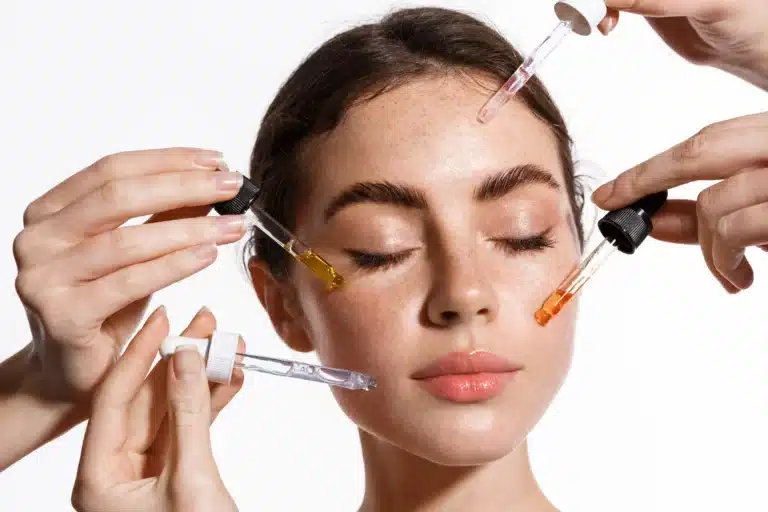
The concept of Glass Skin is based on four fundamental biological parameters which, together, produce perfectly smooth, even and luminous skin.
Glass Skin is above all deeply hydrated, radiant and visibly even skin. Its glow does not depend on a single factor, but on the precise balance between dermal hydration, the quality of the stratum corneum, the regularity of pigmentation and the absence of inflammation. In aesthetic-oriented medicine, achieving such a result is based on a global approach that targets each of these mechanisms.
In medical practice, these parameters are systematically analysed and treated together in order to obtain a coherent, natural and long-lasting result.
The Glass Skin protocol is not only intended for patients wishing to improve the aesthetic appearance of their skin ; it also addresses medical indications frequently encountered in consultations in Geneva.
It is particularly suited to skin suffering from chronic dehydration, often observed in people exposed to dry air, significant climatic variations or prolonged use of unsuitable skincare. It is also a relevant solution for dull skin weakened by oxidative stress, pollution or persistent micro-inflammation. Patients with enlarged pores, superficial acne scars or irregular texture also benefit significantly from it. The Glass Skin protocol is particularly relevant in the early phases of skin laxity, when the production of collagen and elastin begins to decrease.
It is not a superficial or isolated treatment, but a global approach aimed at restoring balanced and long-lasting skin physiology.

Achieving Glass Skin relies on the simultaneous improvement of four essential parameters : deep hydration, even complexion, smooth texture and quality of light reflection. This requires a structured approach acting on the skin barrier, microcirculation, dermal density and cohesion of the stratum corneum. The protocol is never standardised : it is established after a precise clinical examination and is based on a combination of complementary techniques, each targeting a specific biological mechanism. The goal is not to “transform” the skin, but to restore its optimal functioning to obtain a smooth, even and luminous surface.
Deep hydration is the foundation of Glass Skin. Well-hydrated skin regains its elasticity, suppleness and natural ability to diffuse light evenly. Skinboosters, low-crosslinked hyaluronic acid, effectively restore dermal water content and immediately improve skin quality. They act as a true internal water reservoir, essential for maintaining smooth, dense and luminous skin.
Sculptra, by stimulating collagen production, strengthens dermal structure and improves tissue quality in a long-lasting way. The combination of these two techniques provides deep, stable and visible hydration, an essential condition for achieving a true Glass Skin effect.
A regular skin texture is essential for achieving true Glass Skin, as it determines how light is reflected on the skin’s surface. The Hydrafacial treatment combines deep cleansing, controlled exfoliation and the infusion of targeted actives to smooth the skin’s surface, reduce the appearance of pores and correct superficial irregularities. It prepares the skin ideally and immediately enhances its softness.
The PRX-T33 peeling stimulates cell renewal without causing visible desquamation, while evening out the skin. It softens small surface roughness and improves the skin’s tired appearance. The combination of these two techniques provides a uniform texture, an essential condition for achieving the desired Glass Skin effect.
The homogeneous radiance characteristic of Glass Skin relies both on properly nourished skin and on effective microcirculation. Facial mesotherapy, or mesolift, acts directly within the dermis by delivering a targeted blend of vitamins, amino acids, non-crosslinked hyaluronic acid and trace elements. These active ingredients reactivate the skin’s natural glow, correct dull complexion caused by oxidative stress and improve cellular balance. This internal stimulation enhances the quality of the stratum corneum and enables more even light reflection.
Mesotherapy plays an essential role in achieving the Glass Skin effect. By improving the clarity of the complexion and reviving its radiance, it contributes to uniform and long-lasting luminosity. This treatment helps the skin regain freshness, vitality and transparency — indispensable characteristics for the smooth and radiant appearance being sought.
The apparent transparency of Glass Skin relies on an even complexion, free of redness and pigmentation. Medical peelings act on the superficial layer of the epidermis to correct mild pigmentation, refine skin texture and brighten areas where the skin appears dull. By removing dead cells that affect skin uniformity, they immediately improve clarity.
The ablative laser works deeper and targets more pronounced irregularities : resistant spots, superficial scars, uneven texture or dyschromia. By intensely stimulating tissue regeneration, it improves skin quality and promotes a clearer and more even appearance. The combination of these techniques results in a clear, even and optically more transparent complexion — the signature of true Glass Skin.
A Glass Skin can be achieved naturally by adopting a few simple habits : moisturising the skin daily with an appropriate product, protecting the face from the sun to avoid spots and redness, and exfoliating it lightly with homemade scrubs once or twice a week to obtain a smoother surface. A regular, non-irritating skincare routine, combined with good hydration and a balanced lifestyle, helps progressively improve radiance and evenness of the complexion. These measures are helpful, even if they cannot match the more complete effects of medical treatments.
The results of the Glass Skin protocol are progressive but clearly noticeable from the first sessions. Deep hydration results in softer, plumper and visibly fuller skin. Skin quality improves, pores become less visible and the skin surface becomes more even. Radiance improves in a measurable way : the complexion appears clearer and more uniform, with more even light reflection thanks to a better-structured stratum corneum and stimulated microcirculation. Pigment irregularities gradually fade, giving the skin a more transparent appearance. Medically, an improvement in barrier function, a decrease in chronic micro-inflammation and a better dermal quality are also observed. The coordinated combination of techniques provides an overall result : smoother, denser, more stable and long-lasting luminous skin.
The Glass Skin protocol therefore aims for a true improvement in skin health, of which the aesthetic benefits are the direct consequence.
Several techniques can be combined : Skinboosters, Sculptra, medical peelings, Hydrafacial, PRX-T33 peeling, facial mesotherapy and lasers depending on the needs. Each method targets a specific aspect : hydration, texture, radiance or evenness of the complexion.
The number of sessions varies according to the initial condition of the skin, but a complete protocol generally requires several sessions spaced a few weeks apart. Maintenance is then carried out once or twice a year.
Some effects, such as hydration or improvement in skin quality, are visible quickly. Others, such as dermal density or complexion evenness, appear progressively over the course of the sessions.
Yes. The goal is to restore skin function, not to modify facial volumes. The result remains subtle, harmonious and tailored to each patient.
Most of the techniques used do not require social downtime. Some methods, such as ablative lasers, may require a few days of recovery.
The duration depends on skin quality and maintenance. With regular follow-up, the results last several months and are sustained over time.
A regular routine improves the skin’s radiance and quality, but is generally not enough to achieve the Glass Skin effect. Medical treatments make it possible to act in depth on quality, hydration and uniformity.