Home » Conditions » Look » Blepharoplasty scars
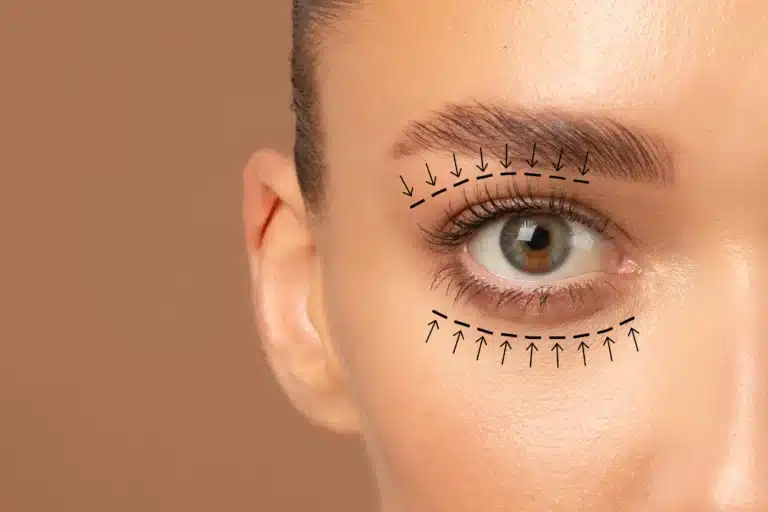
Blepharoplasty, a surgical procedure aimed at correcting excess skin or fat of the eyelids, generally leaves fine and discreet scars, ideally hidden in the natural folds of the eyelids. However, in some cases, the scar may remain visible, irregular, pigmented, red, retracted or slightly painful. These scarring imperfections can alter the harmony of the gaze and be difficult to live with.
Fortunately, recent advances in aesthetic-oriented medicine now make it possible to significantly improve the appearance, suppleness and texture of post-blepharoplasty scars, without the need for another surgical procedure. Thus, the gaze can regain its full expressiveness.
Although the eyelid region naturally has excellent healing capacities, various factors can nevertheless compromise its quality. Excessive tension during skin suturing, prolonged inflammation, particularly thin, dry or fragile skin, an individual tendency to fibrosis or pigmentation, or even premature sun exposure — all these factors can contribute to the appearance of a more visible scar.
It may also happen that a slight skin retraction, or an adhesion between the skin and the underlying tissues, alters the contour and hinders the natural mobility of the eyelid, thus affecting the expression of the gaze. In rare cases, a hypertrophic or pigmented scar may form, even though this phenomenon is much less common on the eyelids than on other areas of the body.
Understanding these mechanisms, as well as the factors that promote them, helps guide the choice of a specific, adapted and truly targeted treatment to optimize the aesthetics and functionality of the gaze.
Blepharoplasty scars are generally fine and discreet, as they are placed in the natural folds of the eyelid. On the upper eyelid, the incision is concealed in the palpebral crease, which makes it almost invisible once the healing process is complete. On the lower eyelid, when an external incision is made, the scar is positioned very close to the lash line, allowing for a progressive and natural integration. In most cases, the scars become difficult to distinguish after a few months. However, in some people, the scar may remain slightly visible, pigmented, retracted, or present a small surface irregularity.
Treating a blepharoplasty scar is not limited to reducing its visibility. The objective goes far beyond that : it is about restoring the skin’s suppleness, density and natural gliding capacity ; improving its color, texture and the integration of the scar within the physiological fold of the eyelid. The treatment also aims to restore smooth and natural tissue mobility, reduce any discomfort during makeup application, and above all preserve the expressiveness of the gaze, a true center of non-verbal communication. Thus, the approach must not be purely aesthetic, but also functional and respectful of the particularly delicate anatomy of this area. When carried out in a thoughtful, progressive manner and adapted to the specific characteristics of each scar, medical management makes it possible to obtain a result that is discreet, harmonious and long-lasting.

During the same session, Dr. Romano combines two laser technologies with perfectly complementary actions : the photorejuvenation laser, whose action is concentrated in the mid-dermis, and the fractional ablative laser, which acts simultaneously on the surface and in depth on the scar tissue. This combined approach allows for a global management, both aesthetic and functional, by improving the suppleness, color and structural quality of the scar.
The session begins with a rigorous preparation : the eyelid area is carefully cleansed, disinfected, and the eyes are then protected with specific ocular shields to ensure optimal safety.
The laser parameters are adjusted with precision in order to respect the sensitivity and thinness of the eyelid skin. The session is generally well tolerated. In the hours that follow, slight redness, mild swelling or a temporary sensation of warmth may appear, but they disappear spontaneously in a short time. The combination of these two lasers constitutes a safe method that is particularly suited to the periocular area.
The photorejuvenation laser acts mainly by diffusing controlled heat within the superficial layers of the skin, without ablation. This thermal energy stimulates the cells of the dermis, particularly the fibroblasts, encouraging them to properly reorganize the cutaneous matrix. Scar tissue, often poorly structured, gradually gains suppleness, density and uniformity. This controlled heat also improves local microcirculation, which reduces redness, regulates pigment irregularities and diminishes the inflammatory appearance of the scar. The goal is not to destroy the skin, but to encourage a physiological, orderly and long-lasting repair. The treatment is non-invasive and does not require social downtime. The eyelids, however, remain very red for two days and cannot be covered with makeup.
The fractional ablative laser works at a deeper level, with both mechanical and biological action. It creates tiny micro-channels in the scar tissue, producing a controlled ablation of certain altered areas of the skin. This process triggers an intense tissue repair, based on the production of a new dermis that is softer, more regular and better organized. By removing part of the pigmented or fibrous tissue, the laser also corrects certain surface irregularities and reduces pigmentations. The synthesis of collagen and elastin is strongly stimulated, which durably improves the quality, mobility and aesthetic integration of the scar. This treatment must be performed with precision and medical expertise.
The results of blepharoplasty scar treatments are progressive but lasting. The skin becomes more supple, more regular, denser, and the scar less visible. It flattens, softens and gradually blends with the surrounding tissues.
The evolution of the scar depends on several parameters : the initial quality of the skin tissue, the type of scar, the time elapsed since the procedure, the regularity of post-treatment care and the individual response to the treatments. Depending on these factors, the improvement may range from a partial reduction — around 30 % with a scar that is softer, finer and better integrated into the palpebral fold — to an almost complete disappearance, with a scar barely perceptible to the naked eye. This personalized estimate of the improvement potential is always discussed during the consultation, in order to offer the patient a realistic vision of the result.
The aesthetic improvement comes with real functional benefit : comfort during makeup application, facial expressions or blinking. The gaze retains all its expressiveness, naturalness and uniqueness.
It is advisable to start massaging the blepharoplasty scar only when the skin is perfectly healed, that is to say when the wound is fully closed, with no residual scabs and no sign of inflammation or local sensitivity. This period occurs, depending on the healing quality and the surgeon’s instructions, between the third and fourth postoperative week. Massage, when performed with method and delicacy, helps prevent the formation of adhesions, improves tissue suppleness and promotes a progressive softening of the scar, making it smoother, more uniform and less visible. It must be gentle, regular, rhythmic but never vigorous, so as not to compromise the integrity of this area where the skin is particularly thin and fragile. The application of a specific moisturizing care or a healing cream reinforces the effectiveness of the technique by optimizing the quality of skin remodeling.
Caring for scars after a blepharoplasty is a crucial step in achieving harmonious, discreet and long-lasting healing. As soon as the stitches are removed, the area must be kept clean, hydrated and effectively protected from external aggressions, particularly ultraviolet rays. The daily application of a healing cream helps stimulate skin regeneration, limit inflammation and preserve tissue suppleness, while progressively improving the quality of the scar. Strict photoprotection using an SPF 50 sunscreen is essential for several months, as the eyelid skin is particularly thin and prone to post-inflammatory pigmentation. Depending on how the scar evolves, additional treatments, including laser sessions, may be recommended to soothe the area, promote microcirculation, stimulate fibroblast activity and thus optimize tissue repair. Finally, regular medical follow-up allows monitoring of scar evolution, anticipating the appearance of potential imperfections and, if necessary, implementing an adapted and personalized treatment plan.
During the treatment of blepharoplasty scars, Dr. Romano systematically combines, within the same session, the photorejuvenation laser and the fractional ablative laser in order to act both on the surface and the deep structure of the scar. The price of one session is 300 CHF. A complete protocol generally includes four sessions, spaced two months apart, in order to respect the rhythm of cellular renewal and obtain optimal healing. The results are progressive but lasting : once the scar is remodeled, maintenance sessions are not necessary. This treatment, with both functional and aesthetic purposes, is not covered by health insurance.
After a blepharoplasty, the scars are generally very discreet, as they are placed in the natural folds of the eyelid. On the upper eyelid, the incision follows the palpebral crease ; on the lower eyelid, it can be hidden under the lashes or performed inside the conjunctiva in certain cases. With time, they become almost imperceptible.
Healing evolves over several months. The initial inflammatory phase lasts two to three weeks. The scar then gradually becomes thinner and lighter between three and six months. The final result is assessed between six and twelve months, depending on each patient’s healing capacity.
Several factors can affect the quality of healing : skin type, sun exposure, age, smoking, skin tension or a predisposition to hypertrophic scars. Thin, dry or fragile skin may sometimes heal in a less homogeneous way, creating slight irregularity or a subtle surface elevation.
There are medical treatments that can improve the appearance of a scar : fractional laser and photorejuvenation laser. These treatments promote skin regeneration, stimulate collagen production and improve the suppleness and uniformity of the scar.
Massage is only recommended once the scar is completely closed, without scabs or redness, generally after three to four weeks. It must be gentle, regular and performed with an appropriate cream, in order to soften the scar, limit adhesions and improve its integration into the natural fold of the eyelid.
Sun protection is essential. A recent scar must absolutely be protected from UV rays for several months, with a high-protection sunscreen (SPF 50). Sun exposure can accentuate pigmentation and make the scar more visible.
Yes, the fractional ablative laser helps smooth the scar, improve it and reduce irregularities. Combined with the photorejuvenation laser, it also acts on color, redness and vascularization. The combination of both lasers in the same session offers an improvement that is both structural and aesthetic.
No, this is not possible. Injecting hyaluronic acid into the eyelid skin causes permanent swelling.
The number of sessions depends on the type of scar, its thickness and its pigmentation. As a general rule, two to four laser sessions spaced two months apart are recommended. The results are progressive, and improvement is often visible from the first session.
It is advisable to wait at least one year after the surgery before evaluating the scar, unless there is significant discomfort. This allows natural healing to take its course. If the scar remains visible, thickened or pigmented, a medical treatment may be considered.