Home » Conditions » Neck » Neck Sagging
Skin laxity is one of the signs of neck aging. Gradually appearing, it is also responsible for the loss of definition of the facial oval.
It is characterized by a loss of firmness and elasticity of the skin, often accompanied by wrinkles and folds.
Often described by patients as a ‘turkey neck’ or ‘a sagging neck’, this aesthetic concern is a frequent reason for consultation.
Treatment of neck skin laxity in Geneva.
The neck skin laxity is a common aesthetic concern in both men and women.
The management of neck skin laxity in men and neck skin laxity in women is the same.
Many anti-aging treatments for the neck have been developed.
In aesthetic-oriented medicine the treatments for neck skin laxity are : neck peeling, neck laser treatment, and hyaluronic acid injections for the neck. These aesthetic treatments are a kind of non-surgical neck lift.
Several factors contribute to neck sagging.
Excess fat in the neck area.
Exposure to UV rays : ultraviolet rays from the sun produce free radicals in skin cells, which progressively damage elastin. This leads to the formation of wrinkles and the loss of skin firmness.
A scale of severity stages of the phenomenon has been established.

Targeted neck exercises can improve local blood circulation and strengthen the neck muscles. While their impact on neck laxity is limited, some patients find them beneficial.
Kiss exercise
Starting position : seated position with the back straight.
Movement : with the mouth closed, slowly lift the chin and purse the lips, as if giving a kiss. Hold this position for five seconds.
Frequency : perform this exercise five times, twice a week.
Neck lifting exercise
Starting position : lying position with the neck slightly sliding over the edge.
Movement : by engaging the neck muscles, slowly lift the head as high as possible, then slowly lower it back down.
Frequency : perform this exercise five times, twice a week.
Neck skin laxity begins to appear around the age of 40. However, the onset of this phenomenon varies considerably depending on various factors, including diet, lifestyle, and sun exposure. These elements play a crucial role in the process of premature skin aging.
Some people may notice skin laxity as early as their forties, while others only see this change starting in their fifties or even sixties.
This is a natural and normal process. Preventive measures and appropriate treatments do exist.
Over time, the skin of the neck becomes loose and wrinkled due to the loss of elasticity and firmness.
Although this phenomenon is completely normal and common with age, there are several solutions to prevent skin laxity and firm the neck after 50.
The treatment of neck skin laxity is often surgical. In some cases, particularly in cases of mild laxity not associated with excess weight, aesthetic-oriented medicine techniques can improve it.

The MM lift is a neck lift that combines hyaluronic acid injections and PRP.
Hyaluronic acid injections provide an immediate result that lasts one year.
Often, the treatment begins with injections performed at the level of the face, Dr Romano carries out the medical lifting technique of the face in order to lift the tissues that sag at the level of the neck.
Several injections, whose localization recalls an M (hence the name), are then performed at the level of the chin and the mandibular line.
The injected points are strategic and adapted to the patient’s morphology. The treatment is tailor-made.
PRP injections stimulate the synthesis of denser skin and hydrate it at the same time. Results are visible two months after the first session.
It is recommended to carry out three sessions at three-month intervals as an initial treatment and one maintenance session per year.
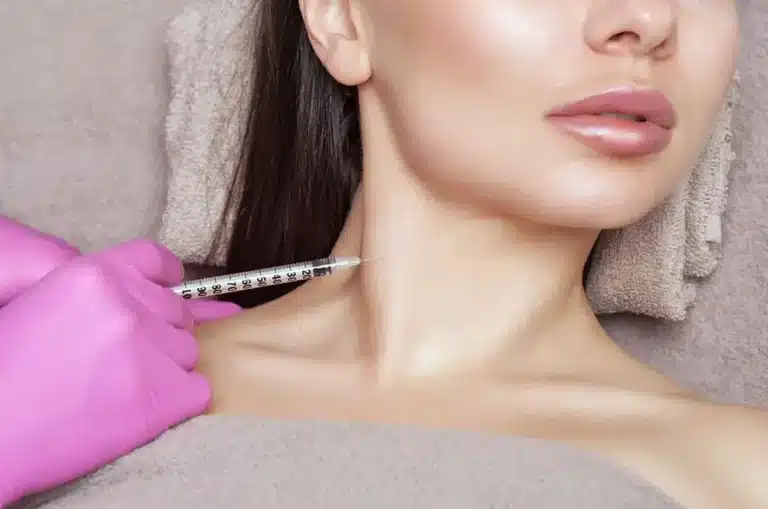
It is an injection of hyaluronic acid.
Ten strategic points are injected, using a cannula or a needle, at the level of the neck. The exact number of points, their location, the injection depth, and the amount of product injected are determined according to the patient’s anatomy.
The hyaluronic acid used has hydrating properties (in order to improve skin quality) and lifting properties.
One to two syringes are required.
This technique is not performed by all physicians.
An unsuccessful injection does not produce results and may cause visible lumps.
The result is immediate and improves over the following month. The tightening effect is visible, and the skin of the neck is more hydrated and firmer.
The only side effects are hematomas, which are rare.
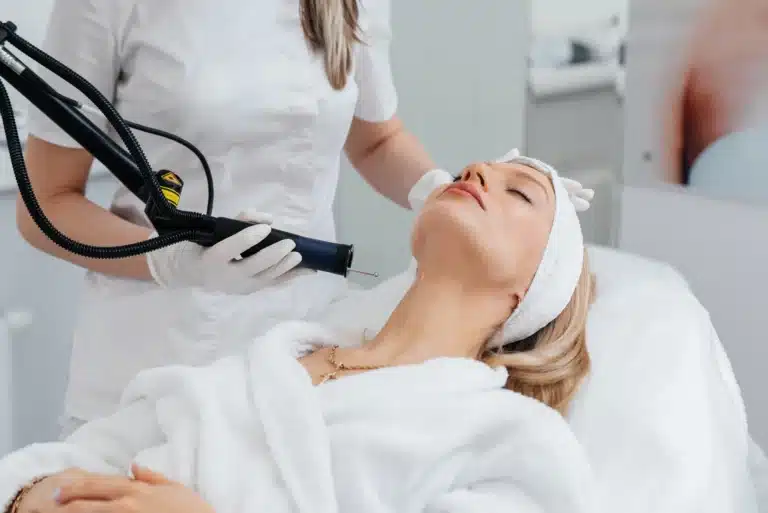
The fractional ablative laser is an effective solution to treat neck skin laxity.
This technique stimulates skin regeneration, as well as the production of collagen and elastin, two essential components for firm and elastic skin.
The results are significant and long-lasting. Quickly visible, they continue to improve over time.
This medical technique also improves skin quality and wrinkles.
The treatment is performed in a medical office. The session lasts approximately 30 minutes. An anesthetic cream is applied one hour beforehand.
After the session, redness and slight swelling may appear, their duration does not exceed a few days.
In some cases, the fractional ablative laser is an alternative to surgical neck lifting.
Neck sagging treatments provide visible and lasting results.
The results are long-lasting but not permanent. Their duration depends on the patient’s anatomy and genetics, as well as the severity of the laxity. The benefits of hyaluronic acid injections last between six and twelve months. The effects of laser sessions last approximately one year.
Neck skin laxity can be managed using different medical techniques, chosen according to skin quality, the degree of laxity, and aesthetic goals. Several solutions are available, each with its specific indications.
The price of a hyaluronic acid injection for the neck is 600 CHF per syringe. This treatment is particularly suitable for lax skin with volume loss or in the presence of marked horizontal wrinkles. One or two syringes will be required depending on the degree of correction sought.
PRP (platelet-rich plasma) is often indicated in cases of thin or crepey skin, to stimulate skin regeneration. The price of one PRP session for the neck is 500 CHF, with several sessions generally required.
Skinboosters are used to improve hydration, suppleness, and skin firmness. They are particularly suitable in cases of mild to moderate laxity. The price of one Skinbooster syringe is 400 CHF, and one to three syringes may be required depending on the area to be treated and the initial quality of the skin.
Finally, fractional ablative laser represents an effective approach for skin showing more pronounced laxity, often associated with texture irregularities or signs of photoaging. The price of one fractional laser session for the neck is 700 CHF, and the protocol includes an initial phase of one to three sessions on average.
The total cost of treatment for neck laxity therefore varies according to the technique chosen, the possible combination of several approaches, and the number of sessions or products required. A personalized treatment plan is established during the consultation in order to propose a tailor-made strategy, adapted to each morphology and each need.
Patients are satisfied with the results obtained.
They appreciate the firmness and softness of the skin, as well as the visible improvement in skin quality and radiance.
It is important to emphasize that not all patients are good candidates for medical treatment. Results are visible only if the indication is appropriate. The analysis carried out during the initial consultation is therefore essential to select patients who may benefit from these treatments.
It is from the forties that neck skin laxity is observed.
The age at which this phenomenon appears depends on several factors : diet, lifestyle, sun exposure, and genetics.
Fractional ablative laser treatment is generally well tolerated. An anaesthetic cream is applied before the procedure.
The duration of the results depends on the treatment performed and the patient’s response. In general, the benefits last from several months to a few years. Maintenance sessions are required to preserve the result.
Good candidates for medical treatment of neck sagging are patients who show signs of mild skin sagging, wrinkles or slight loss of firmness and who are of normal weight or slightly overweight and do not wish to undergo surgery.
Several factors can accelerate neck skin laxity : natural aging, excessive exposure to UV rays, weight fluctuations, smoking, genetics, an unbalanced diet.
To maintain results after treatment for sagging neck, it is advisable to :
The number of sessions required depends on the treatment chosen and the initial condition of the skin. For certain treatments, hyaluronic acid injections, one session is sufficient in most cases.
Whereas for others, laser treatments, several sessions are necessary.
Good candidates for aesthetic neck treatments are patients who present signs of mild skin laxity, who have a normal weight or are slightly overweight, and who do not wish to resort to surgery. A consultation with an experienced physician will make it possible to determine the most suitable treatment.
Fractional ablative laser treatment is generally well tolerated. An anaesthetic cream is applied before the procedure.
It is recommended to : avoid sun exposure for two months if a laser treatment has been performed ; follow the post-treatment instructions provided by your physician ; regularly moisturize the skin ; avoid intense physical activities and saunas for a few days.
There are several effective aesthetic-oriented medicine treatments to firm the skin of the neck.
Aesthetic treatments for sagging necks are safe, but as with any procedure, side effects can occur : redness, swelling, bruising or slight pain. These effects are transitory and disappear within a few days.
The duration of results varies according to the treatment chosen and the patient's individual response. In general, the benefits last from several months to several years. Maintenance sessions are required to maintain the results.